24 Feb 2012 Business Times By NATALIE KOH
GIVEN
how hip Tiong Bahru has become over the past year or so, (what with all the
indie cafes and stores that have popped up in the area), it was only natural that
OH! Open House, an art trail, would swoop in and explore the area before its
rich history is lost forever.
By the time ticket sales started at 3.30pm last Saturday, a long queue had already begun to snake across Tiong Bahru CC where the tour was to commence, despite the sweltering humidity brought on by an earlier shower that day.
Splitting us up into groups of a dozen, volunteers quickly ushered us to our friendly guide who was to lead us to six of the postwar apartments spread across the area. The flats had been transformed into miniature galleries to present works by 15 commissioned artists.
It was the third edition of OH!, with the first being at Niven Road in 2009, and the second at Marine Parade, which drew 1,500 visitors in its run last year.
The idea was to bring art out of the conventional gallery space and into the heartlands for the average person to enjoy. Even better, you get to interact with artists who sometimes join you on the tour, as well as the homeowners, some of whom meet you at the door to invite you in. It's an idea that worked out pretty well. The audience, drawn in by the novelty of this unique, adventure-like concept and the old-school charm of Tiong Bahru, were of all ages and showed genuine interest in the area and the art works. My group, for example, included people who defied all odds to attend the tour, namely four elderly Caucasians, a very pregnant lady with her husband, and an energetic woman with her toddler on her back throughout.
The first stop was the modernised home of an expatriate who had lent her bathroom out to artist Isabelle Desjeux, an ex-scientist who uses her training in Molecular Biology to create art.
Titled Waste Management Laboratory, the work refers to the less glamorous parts of being a scientist. While it had little to do with the heritage of Tiong Bahru, many (though not all) of the others did, which tied in nicely with the cultural vibe of the district. One such piece was by artist Jying Tan who turned one of the homeowner's bedrooms into the installation, Heimlich. Replacing real furniture are pieces of cling-wrap furniture - that is, a bed, cupboard, desk, and even a working lamp made solely of cling film. The furniture, however, was designed to look vintage, so as to ignite memories of the past, while the cling-wrap signifies the preservation of the memories.
Another was I'm a kway, you're a kway, by Stephen Black who had researched the traditional kueh of Singapore, many of which were found in Tiong Bahru, and re-created and re-invented into edible samples for visitors to try. Mother Tongue by Green Zeng shouts at you from the second-floor balcony from a flat, with large, red Chinese characters that urge people to speak more dialect and less Mandarin - a reference to Singapore's Speak Mandarin Campaign. Of course, the fact the Tiong Bahru was once famous for housing mistresses of rich men wasn't left untouched. Artist Marc Gabriel Loh couldn't help but create Den of Beauties, an installation telling the story of a pair of Siamese twins who had run away from the circus to be with a married man. In sharp contrast to these creative works so full of cultural influences are the beautifully renovated interiors of the hosting houses, the hip coffee joints that you pass while walking from flat to flat, and the strikingly clean walkways once filled with illegal pushcarts selling street food of all sorts. It's an unsettling feeling, knowing that while the buildings are being preserved, the culture isn't. Which, perhaps, makes it timely for curator Alan Oei to bring OH! here - before the hipsters fully take over the neighbourhood. As you approach the end of the exhausting 90-minute tour (the four elderlies had given up by this point, though the two mothers trudged on like heroes), you find yourself at Singapore's first Monkey God temple, with a site-specific artwork right next to it. Titled Matter and Principle, by Singapore-based French artist Gilles Massot, the installation reflects on how a traditional icon like the Monkey God still has a place in a contemporary and urban environment, which makes you think, or hope, that all is not yet lost for Tiong Bahru. Oh! Open House continues this weekend, starting from Tiong Bahru CC. Tours are from 4 to 9pm; last tours leave at 8pm. Tickets for adults cost $15; children aged 12 and below, $10. Get your tickets at the door on Feb 25 and 26, starting from 3.30pm. Log on to www.ohopenhouse.com
Copyright © 2010 Singapore Press Holdings Ltd. All rights reserved.
|
Showing posts with label Activities. Show all posts
Showing posts with label Activities. Show all posts
Friday, February 24, 2012
Business Times : Art from the heart on Tiong Bahru trail


Tuesday, February 21, 2012
The Straits Times : Homes wrapped up in art
Six apartments in Tiong Bahru were turned into spaces for artists to exhibit their artworks
The
Straits Times
Life Section
21 February 2012
By deepika shetty
21 February 2012
By deepika shetty
 |
| Visitors to find colourful mobiles made by artist Sokkuan Tye. -- ST PHOTOS: LAU FOOK KONG |
It is an unusual art walk that steers clear of gallery settings and presents art in people's homes.
This year, its third edition, it presents works along a 2.6km route which includes The Monkey God Temple and six private residential apartments.
It will be held again this weekend.
This year, curator and artist Alan Oei and assistant curator Kimberly Shen commissioned 15 artists who presented works spanning photography, video, installation art, mixed media, interactive media and sculptures in six homes.
They picked Tiong Bahru in keeping with the spirit of Open House, which is to take art out of galleries into heartland spaces. In picking this area, Oei wanted to 'capture a snapshot of Tiong Bahru' before it is completely gentrified. The area, known for its pre-war walk-up flats, has become an enclave of hip dining spots, coffee bars and retail stores.
It was not that tough to convince people to open up their homes. Once one of them, banker Jason Ortiz, was on board for the project, he called up his friends in the area.
Drawing on the art-deco aesthetic and nostalgic charm of the conserved pre-war apartments, the artists have tried some rather unusual experiments with the spaces presented to them.
In one home - a walk-up apartment - the balcony has been transformed by local artist Green Zeng, 38, to present Mother Tongue, a tongue-in-cheek look at the use of the Chinese language and its relationship with Chinese dialects. Through a video work and posters of re-arranged slogans from the Speak Mandarin Campaign, the artwork examines the campaign and its connection with the problems facing Singapore's bilingual policy.
While most home owners were not at home as various groups trooped into their apartments on Sunday, the chatty Ortiz, dressed in shorts and a T-shirt, greeted visitors to his walk-up rental apartment with a large ceramic bowl filled with candies.
The 31-year-old, who grew up in the United States, was one of five owners photographed in the buff for the art walk. Singapore-based Taiwanese photographer Lavender Chang took the pictures while they were asleep in the nude. The blurry images portray the subjects in an unconscious state.
Although Mr Ortiz was initially reluctant about being photographed, he said he has 'really embraced the art' now.
 |
| Home owner Jason Ortiz had a room in his apartment filled with furniture made with packing material by artist Jying Tan -- ST PHOTOS: LAU FOOK KONG |
'When I was approached by the organisers, it sounded cool to me. How often do you get a chance to exhibit art, apart from the painting on the wall? I felt it was a great idea to open my home to artists, show people the art and welcome them to see it,' he said.
In another bedroom, he moved all the furniture into the narrow corridor near his kitchen, allowing 24-year-old artist Jying Tan to create her installation titled Heimlich.
Her ethereal work is inspired by her memory of moving home. She has reconstructed objects from her bedroom including her bed, wardrobe, stool, table and a chest of drawers using fragile packaging material including clingwrap and 'lots of scotch tape'.
The soft-spoken artist, who is a master's student at Lasalle College of the Arts, said: 'I was very lucky as Jason gave me the key to his home. The work has been very labour-intensive and he was totally supportive of what I was doing. I started work in late October, finishing it just in time for the opening. Some people tell me it looks rather ghostly. My attempt is to look at displacement and how we adapt to different environments.'
The idea for Open House came from Mr Oliver Bettin, a trader with Deutsche Bank in Singapore. The Briton had given the garage space in his shophouse home to an artist who used it as her studio. Open House grew out of that concept of living spaces being used for art making, art viewing and art appreciation.
The first Open House took place in a row of pre-war shophouses along Niven Road in December 2009 drawing 700 people over three nights. Last year, more than 1,500 visitors traipsed through five HDB flats in Marine Parade.
Public relations professional Ping Ping Tan, who was in the Tiong Bahru neighbourhood for lunch with friends, joined the art walk by accident.
'I just stumbled upon the event, thanks to my friends. I grew up in this neighbourhood and I think this is a great way of not just seeing the artworks but also look at how people live,' said Ms Tan, 36.
Ms Samantha Chan, 26, a lecturer who has attended all three Open Houses, gave it the thumbs up.
'Every area is different and the organisers put in real thought into what they show. The art works in the environments they have been presented in.'
At the Monkey God Temple, where Singapore-based French artist Gilles Massot showed his installation with projections and wayang kulit (Indonesian shadow puppets), the mysterious stories of the Monkey God came alive.
Briton Philip Morgan, a digital media specialist who has lived in Singapore for 16 years, has volunteered at all three Open Houses. For this edition, he spent several weeks researching about the estate, reading up books, articles and 'everything available on the Internet'.
'The beauty of Open House,' he said, 'lies in finding out what lies behind closed doors.'
deepikas@sph.com.sg
book it
OH! OPEN HOUSE
Where: Tours start at Tiong Bahru Community Centre, 67A Eu Chin Street
When: Saturday and Sunday, 4 to 9pm. Last tour leaves at 8pm
Admission: $15 tickets sold at the door
Info: www.ohopenhouse.com
Friday, January 27, 2012
MyPaper : Wartime survivors recall the day bombs fell
MyPaper
27 January 2012
By Josephie Price
JAN 21, 1942, is a bittersweet
date for lawyer Mary Pereira.
"That was the day her
father, a World War II civil-defence volunteer, was killed in Japanese air
raids. It was also the day that her
shell-shocked mother gave birth to her in an air-raid shelter, as bombs fell like
rain outside.
"We were homeless after that
night of bombing. I didn't know it at the
time, but my mum told me thatwhole
buildings were destroyed and our flat was taken over," said Ms
Pereira.
Opportunists moved into their
home after the bombing and changed the lock.
Without a home, the Pereira family
moved to Malaysia for some years to live with relatives.
Yesterday,
some 70 years after that fateful day, Ms Pereira visited the same shelter in
Tiong Bahru for the first time. She was accompanied by her two older brothers, who recounted the grim events.
One of them,
retiree Andrew Pereira, was just five years old that
year.
Now 75, Mr Pereira said that as a
boy then, the experience of seeing planes in the sky and hearing sirens
everywhere "was like something out of movie ".
"My uncle grabbed me from my
bed and carried me and my brother down to the shelter, where we waited until it
was safe to come out again,"he added.
Built in 1940, the Tiong Bahru
air-raid shelter, located beneath Block 78 in Guan Chuan Street, is the only
pre- war civilian air-raid shelter that still exists here.
The apartment block above it was
the only public-housing building at the time
to be equipped with an air-raid shelter.
To
commemorate the 70th anniversary of the Battle of Singapore, the National Heritage Board (NHB) is conducting
public tours of the air-raid shelter.
Two free guided tours lasting an
hour each will be conducted every Saturday
next month. Each tour can take up to 25 participants, and registration can be made
online.
An
exhibition on air-raid shelters will be launched at Tiong Bahru Market next Saturday to serve as a counterpart to the tours. The exhibition will
showcase artefacts, such as pictures and newspaper articles, from the Imperial War Museum in
London.
The two
projects are part of a broader initiative by the
NHB to highlight, until the end of June, some of the. lesser-known stories of Singapore's wartime past.
Said Mr
Alvin Tan, NHB's director of heritage institutions: "Through this project,
we hope that members of the public,
especially Singaporeans, will learn more about Singapore's war history."
He added
that the agency also wanted to highlight the resilience of Singaporeans
"in this particular difficult time in our nation-building".
For more information and to sign
up for the tours, go to www.nhb.gov.sg/battleforsg
 |
|
A
VISIT to a World War It air-raid
shelter in Tiong Bahru yesterday brought back bittersweet memories for the
Pereira family. The shelter was where
Ms Mary Pereira was born in January 1942, amid a Japanese air raid. Her
brothers, Andrew, 75, and Erasmus, 71, remember
the sirens' blare and bombs falling like "something out of a
movie".
 |
The Straits Times : She was born in this air-raid shelter
The
Straits Times
27 January 2012
By Lim Yan Liang
Siblings and World War II survivors Erasmus Pereira, 73, Andrew Pereira, 75, and Mary Magdeline Pereira, 70, visiting the 1940 civilian air-raid shelter at Block 78 Guan Chuan Street in Tiong Bahru.
It was here 70 years ago, as bombs fell on the housing estate outside, that Ms Pereira was born.
Built by the now defunct Singapore Improvement Trust, the shelter was the only one of its kind to be incorporated within public housing.
It will be opened to the public for the first time next month.
27 January 2012
By Lim Yan Liang
 |
Siblings and World War II survivors (from left) Erasmus Pereira, 73, Andrew Pereira, 75, and Mary Magdeline Pereira, 70, visiting the 1940 civilian air-raid shelter at Block 78 Guan Chuan Street in Tiong Bahru. -- ST PHOTO: ALPHONSUS CHERN
|
It was here 70 years ago, as bombs fell on the housing estate outside, that Ms Pereira was born.
Built by the now defunct Singapore Improvement Trust, the shelter was the only one of its kind to be incorporated within public housing.
It will be opened to the public for the first time next month.
Thursday, January 26, 2012
The Straits Times : World War II bomb shelter opens for tours
Tiong Bahru site could be the last wartime civilian shelter here
The Straits Times
The Straits Times
27th January 2012
 |
Photograph of the interior of the 1940s civilian air raid shelter at Block 78 Guan Chuan Street in the Tiong Bahru housing estate constructed by the then-Singapore Improvement Trust. -- ST PHOTO: ALPHONSUS CHERN
|
The shelter, occupying the ground floor of Block 78, Guan Chuan Street in a quiet corner of Tiong Bahru, has had an anonymous existence all this time.
No signs have pointed casual passers-by to it, and the whitewashed brick walls of its exterior betray little of the purpose for which the 1,500 sq m space was built.
 |
The shelter occupies the ground floor of Block 78, Guan Chuan Street, and has been used by the Housing Board as a storage space. -- ST PHOTOS: ALPHONSUS CHERN
|
But it was this space that gave about 100 people from the neighbourhood shelter during the Japanese air raids between December 1941 and January 1942, shortly before Singapore fell during World War II.
Built in 1940 by the Singapore Improvement Trust, the colonial predecessor to the Housing Board, it was the only air-raid shelter to have been incorporated into public housing at the time.
The National Heritage Board (NHB), seeking to mark the 70th anniversary of the battle for and eventual fall of Singapore, will organise the tours. It will also launch a community exhibition at the nearby Tiong Bahru market.
 |
The white-washed brick walls of the shelter's exterior betray little of the purpose for which the space was built in 1940.
|
Photos, oral accounts and material gleaned from Britain's Imperial War Museum will tell the history of pre-war and wartime air-raid shelters here.
The tours and exhibition are part of a larger schedule of events to mark the anniversary. These include an exhibition of artwork by former prisoner of war William Haxworth and Singaporean artist Liu Kang at the National Library, the launch of heritage trails at Reflections At Bukit Chandu, and a remembrance ceremony at the Kranji War Memorial on Feb 15, 70 years to the day Singapore fell.
Mr Alvin Tan, the NHB's director of heritage institutions and industry development, said: 'The guided tours and exhibition are part of the overall experience that NHB is providing to commemorate the Battle for Singapore.'
He said the NHB hopes to raise public awareness of Singapore's war history and highlight the people's resilience in that early phase of nation-building.
Although in good condition, the shelter is not entirely in its original state. The HDB, which has been using the shelter as a storage space, retrofitted it with fluorescent lights.
Other changes, which Mr Tan described as 'minor renovations', included the knocking-down of some walls, and the cementing-over of some original entrances and skylights. Little will be done to the space ahead of visits by history buffs and students of Singapore history.
 |
The exposed red bricks of the 1,500 sq m shelter's interior walls are unadorned. Overhead, planks and pipes run, unhidden, and the concrete ceiling and pillars are unpainted.
|
The exposed red bricks of the interior walls are unadorned. Overhead, planks and pipes run, unhidden, and the concrete ceiling and pillars are unpainted.
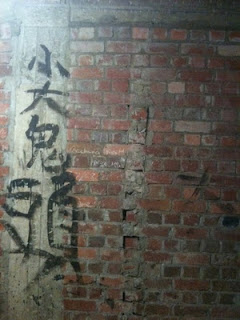
Some graffiti, including Chinese characters in black paint, are on the walls in the shelter, but the NHB is unsure when these marks were made.

 |
Visitors may be able to spot Chinese characters on the walls, such as the word gui (meaning ghost), as well as pictures of Chinese actors and actresses in period garb near one of the ceilings. -- ST PHOTOS: ALPHONSUS CHERN
|
Just five years old when the bombs began falling on Singapore, he said: 'It was spacious down there, but dark, and if I recall correctly, we had just a few kerosene lamps.'
The sound of the air-raid siren is etched in his memory, he said, as are the bright beams of searchlights that criss-crossed the sky outside the shelter.
One reason the shelter is intact could be because it was little used.
Mr Peter Chan, a 58-year-old businessman whose grandfather Chan Chun Wing was a volunteer air-raid marshal in Tiong Bahru, said only one dry run of evacuation to the shelter was held - in the daytime - after the shelter was built ahead of the war.
But the Japanese launched their bombing campaign on Singapore at 4am on Dec 8, 1941. At that hour, most residents were asleep in their own homes and under-prepared to evacuate to the shelter, although it was used the following month.
Mr Chan said: 'My grandfather said people nearby did use the shelter when the sirens went off, but those were mostly false alarms. It was actually hardly used.'
yanliang@sph.com.sg
____________________________________________
Father died, sister was born - all within 24 hours
IN THE early hours of Jan 21, 1942, amid intermittent bombing raids on Singapore by the Japanese, Mr Callistus Raymond Pereira, a 29-year-old teacher and father of two, was called to duty as a civil defence volunteer.
He had breakfast with his wife Gerarda, who was expecting their third child soon. Before leaving the family's home in Chay Yan Street, he went to kiss his sleeping sons, Andrew, five, and Eddy, four, goodbye.
As there had been heavy bombing the day before, he had a bad feeling about that day. He took a picture of the Virgin Mary that he kept in a drawer, passed it to his wife and said: 'Don't worry, if anything happens, Our Lady will look after you.'
When he did not return that evening, his wife knew he was gone. She headed for the hospital mortuary in Outram Road, determined to claim his body and give him a proper burial.
But she could not find his body amid the chaos at the mortuary, on a day when 600 people lost their lives.
Later that evening, after she got home, the air-raid sirens went off.
As they howled, she took her sons to the air-raid shelter in Block 78, Guan Chuan Street. The elder of the boys, Andrew, a former lab technician now aged 75, said he remembers being carried into the shelter with Eddy.
'The sirens were blaring. There were bombed-out houses with only the staircases left standing.'
His most vivid memory of life in the shelter, though, was the charcoal fire the adults built inside. Over it, they roasted a long pisang tanduk, or horn banana.
He said: 'I was only five, so I don't recall much, but we ate the bananas with butter, and it was wonderful.'
Later that night, Mrs Pereira went into labour, and by a stroke of luck, Professor J.S. English, Singapore's first professor of obstetrics and gynaecology, was in charge of the medical unit in the shelter.
With help from him and his wife, Mrs Pereira delivered Mary Magdeline Pereira just after midnight on Jan 22, 1942.
Ms Pereira, a retired teacher now aged 70, said: 'If there had not been an air-raid shelter, I don't know if I would have been born safely - or if I'd even be alive now.
'Singapore was razed to the ground that day, and I am like the phoenix that rose out of the ashes. That spirit is in me. I've been a fighter all the time - that's me.'
The family learnt from a historian after the war that a 'C R Pereira', recorded to have died on Jan 21, 1942, lies buried in a mass grave in Batu Pahat, Johor.
LIM YAN LIANG
_________________________________________________
HOW TO SIGN UP
Two guided tours, each lasting an hour, will take place every Saturday morning at 10am and 11am in February. Members of the public may register for them by emailing lee_bee_cheng@nhb.gov.sg
TODAYonline : Catch a glimpse of history at this pre-war air raid shelter
TODAYonline
Jan 26, 2012
Jan 26, 2012

SINGAPORE - The only known existing pre-war civilian air raid shelter will be open for free public tours through the entire month of February.
Located at Block 78 Guan Chuan Street at Tiong Bahru estate, this tour of the underground premise is part of the National Heritage Board's (NHB) efforts to mark the 70th anniversary of the fall of Singapore to the Japanese.

The shelter, opened to the media today, showed glimpses of Singapore's history where fearful civilians would climb down a ladder to seek safety between the uncovered brick walls of the 1,500-square metres shelter.
The shelter's three entrances have since been sealed, and what remains is mainly spacious unfurnished rooms with interesting graffiti - dating back to the 1960s - on the walls.
Ms Mary Peraira, 70, who was born in this shelter shared her experiences with reporters this morning.
"It was a closure for me to know what my mother went through and to be back here knowing what happened then," she said.
Ms Peraira was born just one day after her father died from an air raid. On the night of her birth, the sirens had once again sounded to alert people of another air raid and Ms Peraira's mother and siblings hurried into this shelter to seek refuge.
Public tours of this shelter could be extended after February depending on demand. NHB will also be organising exhibitions and a series of commemorative activities to mark the 70th anniversary.
Located at Block 78 Guan Chuan Street at Tiong Bahru estate, this tour of the underground premise is part of the National Heritage Board's (NHB) efforts to mark the 70th anniversary of the fall of Singapore to the Japanese.

Singapore's only known existing pre-war civilian air raid shelter. Photo by Ng Jing Yng
The shelter's three entrances have since been sealed, and what remains is mainly spacious unfurnished rooms with interesting graffiti - dating back to the 1960s - on the walls.

Singapore's only known existing pre-war civilian air raid shelter. Photo by Ng Jing Yng
Ms Mary Peraira, 70, who was born in this shelter shared her experiences with reporters this morning.
"It was a closure for me to know what my mother went through and to be back here knowing what happened then," she said.
Ms Peraira was born just one day after her father died from an air raid. On the night of her birth, the sirens had once again sounded to alert people of another air raid and Ms Peraira's mother and siblings hurried into this shelter to seek refuge.
Public tours of this shelter could be extended after February depending on demand. NHB will also be organising exhibitions and a series of commemorative activities to mark the 70th anniversary.

Singapore's only known existing pre-war civilian air raid shelter. Photo by Ng
Jing Yng
Saturday, July 2, 2011
The Straits Times : Soul Sketches
A sketch-exhibition of buildings in Tiong Bahru is back again after a successful run last year
The Straits Times
Life Section
By Magdalen Ng
2nd July 2011

Sketches by Tia Boon Sim (above) and Miel Prudencio (below) will be up for sale at the exhibition. PHOTOS: WHITE CANVAS GALLERY

A Tiong Bahru-themed art exhibition did so well last year that it is returning to the retro-fabulous neighbourhood from tomorrow.
Tiong Bahru Revisited features more than 70 sketches of the Housing Board estate at the White Canvas Gallery, also located in the neighbourhood. The exhibition ends on July 17.
Inspired by the old-school architecture in the area, the works are mainly by four artists - Tia Boon Sim, Paul Wang, Don Low and Miel Prudencio.
The display follows Tiong Bahru Sketches: Outside-In, which ran at the same venue for two weeks around the same time last year.
Tia, 56, who teaches at Temasek Polytechnic's School of Design, says: 'The response last year was so good more than 90 per cent of the works were sold, and some residents even complained that the works they wanted were sold.'
The sketches on display are priced from $600 to $2,000. Works at last year's exhibition sold for between $250 and $900. This year, four works are up for bids in a charity silent auction in aid of the Ability Centre in Tiong Bahru. The centre is run by the Society Of The Physically Disabled.
Most of the drawings were done on weekends. The four artists are part of Urban Sketchers, a global network of artists who draw the cities they live in or travel to. Started by Seattle journalist and illustrator Gabi Campanario in 2007, The Singapore Chapter, set up in 2009, has about 20 regulars now.
Miel, 47, a Straits Times senior executive artist, says the laidback vibe of the iconic area draws him back to it. But he does more than just draw there: 'I would sit there, have kopi and read my book.
'It is almost provincial, yet just a bus ride away from the heart of the city,' adds Miel, who lives in Redhill, an MRT stop away from Tiong Bahru.
There are already plans for next year's exhibition. For that, the artists hope to focus on the back alleys and rooftops of the area. The group is also considering expanding their sketch-exhibition to other heritage areas in Singapore, such as Joo Chiat.
'The more we draw the same buildings, the more we find interesting facets of them. I guess it is the interplay of light and shadows at various times of the day,' says Miel.
Freelance designer and illustrator Low, 40, says the area holds special significance for him. As a child, he lived in nearby Kim Tian Place for 12 years.
The part-time instructor at the Nanyang Technological University's School of Art, Design & Media says: 'The more I sketch, the more I like this place, so I haven't ventured out of it.'
Gallery manager and curator Gerald Tan says: 'We plan to have street names at the exhibition and group the paintings according to that. It will be like a mini-Tiong Bahru in the gallery.'
songyuan@sph.com.sg
view it
TIONG BAHRU REVISITED
Where: White Canvas Gallery, 78 Guan Chuan Street, 01-41
When: Till July 17. Tuesdays to Saturdays, noon to 8pm, Sundays, 10am to 6pm. Closed on Mondays and public holidays
Admission: Free
Info: Call 6220-8723
Monday, April 11, 2011
Public Speaking : Art Deco Singapore

Have you ever wondered where the architects of the Tiong Bahru Estate got their inspirations from?
Even though the facade were European, the layout within these apartments are adapted locally.
Let Andrew Tan share with you his findings and research.
Andrew Tan is the person I consult with whenever I have questions about the architecture of Tiong Bahru and he never hesitates to share his knowledge and time.
Besides the PREWAR architecture, Andrew Tan will also touch on the architecture design of the POST WAR side as well!
You will be surprised with some of the twist and turn of events which resulted in the current design that we have there right now.
SPEAKER : ANDREW TAN
DATE : 16th April 2011
TIME : 3pm
VENUE : Chan Hampe Galleries, 21 Tanjong Pagar Road #04-02
SEATS ARE LIMITED, so make sure you RSVP fast at rsvp@chanhampegalleries.com
Friday, March 11, 2011
The Straits Times : Pick favourite spot for heritage trail
The Straits Times
By Jeremy Au Yong
11th March 2011
Residents can soon nominate key areas of communities to highlight their unique identities

RESIDENTS will soon be able to nominate their favourite old local hawker stall or mamak shop in their neighbourhood as a heritage site, in a move to create more heritage trails to highlight the unique identities of communities across Singapore.
Mr Lui Tuck Yew, the Minister for Information, Communications and the Arts, said yesterday that the Government will work with residents, schools and grassroots leaders to 'identify important areas in their communities, mark them as heritage sites, and incorporate them into new heritage trails'.
'These could include places of worship, cultural institutions, famous businesses and even hawker stalls,' he added.
The step is being taken as part of a multi-pronged approach to foster a sense of belonging among Singaporeans.
Mr Lui announced this effort in his reply to Madam Ho Geok Choo (West Coast GRC) and Nominated MP Calvin Cheng, who both voiced concerns over how a recent influx of foreigners might impact Singapore's national identity.
He also stressed that the increased presence of foreigners had not shaken Singapore's identity.
'On the contrary, I believe they have enriched it. We must remember that we are a city built by immigrants from distant lands. As the Chinese saying goes: Hai na bai chuan, you rong nai da - an ocean is great because it accepts all rivers flowing into it.
'Likewise, we should, as we have in the past, welcome those who want to contribute, weather ups and downs together, and weave their unique cultures into our social fabric.'
He added, however, that Singapore must encourage its people to think and talk about what made them Singaporean.
He highlighted many of his ministry's initiatives aimed at doing just that. At the heart of these efforts was getting ordinary Singaporeans involved in fostering this national identity.
Just as it would work with the ground to identify heritage sites in the neighbourhoods, his ministry also wanted to equip communities with skills and funding to develop their own heritage activities.
The Singapore Memory Project, started last year to capture national memories, similarly wanted personal stories from the people. So far, it has received contributions from more than 40 community and institutional partners.
This year's Singapore Arts Festival will also have an eye on national identity. It's theme is I Want To Remember, and will feature an interactive People's Exhibition at six venues islandwide. It will piece together videos, photographs and other mementoes, contributed by people, of old performing places such as the National Theatre and Great World.
Another festival - the Singapore Heritage Festival - will, for the first time, bring its opening and closing events into the heartland. The festival uses performances and exhibitions to raise awareness of Singapore's rich heritage.
But Mr Lui's speech was not all about preservation. One section was devoted to an aspect of Singapore's national identity he hoped to change: lack of graciousness.
While pointing out some government campaigns, he noted that what was more crucial was for every Singaporean to try and make kindness part of their DNA.
'While we have made progress over the years and particularly so during the occasions when the spotlight is on Singapore, we can do more to bring kindness and graciousness into our daily lives,' he said.
jeremyau@sph.com.sg
Friday, September 3, 2010
WOW! A book about Tiong Bahru!
If you have time to spare on 9th September from 5-9pm, take a stroll down to the White Canvas Gallery along Guan Chuan Street to meet up with the author of the book, Black & White Tiong Bahru.
Here's the flyer which the white canvas gallery owner, Colin, passed to me.

And I've reproduced the text on the flyer here for easy reading :
White Canvas Gallery invites you to learn about our first book project, Black and White Tiong Bahru.
Now in production, Black and White Tiong Bahru combines original imagery and research with insightful writing to create a dynamic portrait of this unique area.
On Thursday, September 9th, from 5-9 PM, artist/writer Stephen Black will show photographic work and discuss topics related to the book.
You are invited to join us for this casual meet-the-artist session.
Light refreshments will be served.
A resident of Singapore since 2002, Stephen Black brings to the project a perspective that is both localized and global.
Black has worked with Annie Liebowitz, Kazuo Ohno, David Sylvian and Kenzo. as well as CNN. Fox, Cartoon Network, and Fuji TV.
His book, Bus Stopping, is a critically acclaimed photographic look at Singapore.
Recently, he created text for Michael Lee's installation at the National Museum and also performed as a member of show in the Lit Up Festival at LASALLE College of the Arts.
White Canvas Gallery is located at :
78 Guan Chuan Street #01-41
Singapore 160078
T : 62208723
E : wcg@whitecanvas-gallery.com
W: www.whitecanvas-gallery.com
Monday, August 23, 2010
I will give way to this anytime!
I was on my way home at about 2:15pm today when I was stopped by this funeral procession at the junction of Chay Yan Street and Guan Chuan Street.
Since I cannot go anywhere but to wait, I thought I might as well record this event with my phone camera.
For an event that is supposedly sombre in nature, this one is quite a colourful one.


And my youngest daughter who will wake up to the the sound of thunder miraculously slept through this procession of gongs.
Monday, July 5, 2010
The Straits Times : Tiong Bahru's draw
The Straits Times
Life!
By boon chan
Jul 5, 2010
Tiong Bahru is turning out to be one of the most inspiring neighbourhoods in Singapore.

The sketches are by four artists: Tia Boon Sim, manager at Temasek Design School; Paul Wang, a lecturer at Temasek Polytechnic; Don Low, a graphic designer; and Miel Prudencio, senior executive artist with The Straits Times.
Over 60 per cent of the more than 40 pieces in pen, ink and watercolour have been sold, according to gallery owner Maria Ng. They cost between $250 and $900 and were drawn over several weekends in May and last month.

On the allure of Tiong Bahru, Ms Ng says: 'In a sense, you can't find another place like that in Singapore. In terms of location, it is very central but when you walk through the back lanes, it's a very kampung feeling.'

Architect Kelvin Ang, 38, who is a resident there, agrees. He says: 'There's a stronger sense of community in Tiong Bahru because the design of the neighbourhood helps you to meet people - the small scale of it, the five-foot-way, the balconies and back staircases.'
He is a member of the Seng Poh Residents' Committee in Tiong Bahru and his two-bedroom walk-up apartment is featured in several sketches by Wang. He has bought two of the sketches, but not those of his own home as 'that would be too indulgent'.

Another distinctive feature of Tiong Bahru is the architecture. Mr Leong In Chau, 56, who has lived there for over 20 years, says the buildings are pre-war. He says: 'I like the architectural details so I live there.'
While he likes the sketches, he says with a laugh that he is not planning to buy anything as there are no drawings of his block in Eng Hoon Street.
In addition to the nostalgic charm of the low- rise walk-ups, there is also the draw of the food.
Tia admits: 'Everytime we go down to sketch, we would end up eating somewhere. We know every eating corner there.'
This is lovingly reflected in the depictions of famous foods and restaurants such as Tiong Bahru Chwee Kuey by Low, and Ting Heng by Wang.

Tia's passion for sketching extends beyond the Tiong Bahru project. She founded the Singapore chapter of Urban Sketchers, a global organisation started by Seattle journalist and illustrator Gabi Campanario in 2007. The organisation's aim is to show the world one drawing at a time. She has also organised sketch walks to neighbourhoods such as Little India and Geylang and the results can be seen at urbansketchers-singapore.blospot.com
Those who are keen to learn more about drawing on location can sign up for a sketch walk with the four artists on July 17.
Miel, 45, says: 'Those who sign up are expected to sketch with us and pick up sketching tips from us and we could also act as mini-tourist guides.
'But the piece de resistance would be this - learning where the best food is to be found after all that walking and sketching.'
bchan@sph.com.sg
--------------------------------------------------------------------------------
view it
TIONG BAHRU SKETCHES: OUTSIDE-IN
Where: White Canvas Gallery, 78 Guan Chuan Street, 01-41 Tiong Bahru
When: Until July 17
SKETCHWALK @ TIONG BAHRU WITH TIA BOON SIM, MIEL, PAUL WANG AND DON LOW
Where: Meet at the gallery
When: July 17, 2pm
Info: Call 6220-8723 or e-mail ricky@whitecanvas-gallery.com
Life!
By boon chan
Jul 5, 2010
Tiong Bahru is turning out to be one of the most inspiring neighbourhoods in Singapore.

The artists (front, from left) Tia Boon Sim, Paul Wang, Don Low and Miel (standing) with their sketches of Tiong Bahru. -- PHOTOS: WHITE CANVAS GALLERY
First there was the documentary, Civic Life: Tiong Bahru, shot by London-based film-makers Joe Lawlor and Christine Molloy last month.
Now, there is an exhibition titled Tiong Bahru Sketches: Outside-In at the new White Canvas Gallery which opened last Wednesday. It will be on till July 17.
The sketches are by four artists: Tia Boon Sim, manager at Temasek Design School; Paul Wang, a lecturer at Temasek Polytechnic; Don Low, a graphic designer; and Miel Prudencio, senior executive artist with The Straits Times.
Over 60 per cent of the more than 40 pieces in pen, ink and watercolour have been sold, according to gallery owner Maria Ng. They cost between $250 and $900 and were drawn over several weekends in May and last month.

Corner 71 (above), a pen, ink and watercolour on paper sketch by Tia Boon Sim

Backlane (above) a pen, ink and watercolour on paper sketch by Miel
He is a member of the Seng Poh Residents' Committee in Tiong Bahru and his two-bedroom walk-up apartment is featured in several sketches by Wang. He has bought two of the sketches, but not those of his own home as 'that would be too indulgent'.

Kelvin's Balcony (above), a sketch by Paul Wang
Another distinctive feature of Tiong Bahru is the architecture. Mr Leong In Chau, 56, who has lived there for over 20 years, says the buildings are pre-war. He says: 'I like the architectural details so I live there.'
While he likes the sketches, he says with a laugh that he is not planning to buy anything as there are no drawings of his block in Eng Hoon Street.
In addition to the nostalgic charm of the low- rise walk-ups, there is also the draw of the food.
Tia admits: 'Everytime we go down to sketch, we would end up eating somewhere. We know every eating corner there.'
This is lovingly reflected in the depictions of famous foods and restaurants such as Tiong Bahru Chwee Kuey by Low, and Ting Heng by Wang.

Monkey God Temple (above) a pen, ink and watercolour on paper sketch by Don Low
Tia's passion for sketching extends beyond the Tiong Bahru project. She founded the Singapore chapter of Urban Sketchers, a global organisation started by Seattle journalist and illustrator Gabi Campanario in 2007. The organisation's aim is to show the world one drawing at a time. She has also organised sketch walks to neighbourhoods such as Little India and Geylang and the results can be seen at urbansketchers-singapore.blospot.com
Those who are keen to learn more about drawing on location can sign up for a sketch walk with the four artists on July 17.
Miel, 45, says: 'Those who sign up are expected to sketch with us and pick up sketching tips from us and we could also act as mini-tourist guides.
'But the piece de resistance would be this - learning where the best food is to be found after all that walking and sketching.'
bchan@sph.com.sg
--------------------------------------------------------------------------------
view it
TIONG BAHRU SKETCHES: OUTSIDE-IN
Where: White Canvas Gallery, 78 Guan Chuan Street, 01-41 Tiong Bahru
When: Until July 17
SKETCHWALK @ TIONG BAHRU WITH TIA BOON SIM, MIEL, PAUL WANG AND DON LOW
Where: Meet at the gallery
When: July 17, 2pm
Info: Call 6220-8723 or e-mail ricky@whitecanvas-gallery.com
Thursday, April 29, 2010
The Straits Times : Tiong Bahru, the movie
The Straits Times
Life!
Apr 29, 2010
By Magdalen Ng
London-based film-makers Joe Lawlor and Christine Molloy were shocked during their first visit to Tiong Bahru Market when their order of carrot cake arrived.

'It looked nothing like the carrot cake that we were used to. But it's quite good, actually,' says Lawlor in a recent interview with Life! at the Tiong Bahru Market.
Now he and his wife are no longer strangers to the market and even know which hawker stalls are the most popular.
They have been speaking to store owners and visitors to the area as part of their research for the next short film that they are making.
Set in and around the Tiong Bahru estate, the movie is part of Civic Life: Tiong Bahru, a community arts project exploring identity, memory, architecture, a sense of place and civic space that will take place in the second half of this year.
The project is a collaboration between the British Council and the National Museum of Singapore with support from the Singapore International Foundation. There will also be an online film competition for Singaporeans.
'The British Council is a cultural relations agency whose aim is to create meaningful discussions around the ideas of creativity, culture and education. This project involves close collaboration with our Singaporean partners and a rich engagement between Singaporean and British artists,' says Mr Dan Prichard, director of programmes of the British Council in Singapore.
He adds: 'Joe and Christine's films are beautiful, but it is their commitment to the community and their engagement with the community at all levels in the project that make the Civic Life films so special.'
Lawlor and Molloy's movie, as yet untitled, is the third in a series of short films involving communities that they are making.
The first two Civic Life films were set in Dublin, Ireland, the duo's hometown. Moore Street was filmed along the iconic street where many migrant communities settle, while Leisure Centre focused on the leisure centre situated on Main Street Ballymun, which has long been associated with crime and poverty in the media. Both films were praised at various international film festivals.
For their Singapore film, they surveyed other places including Bedok before deciding on Tiong Bahru, because it is one of the oldest estates in Singapore, and is a place rich with history and culture. Also, almost every Singaporean they encountered seemed to have an opinion about Tiong Bahru Market.
'Some of the people we spoke to used to live here and have since moved away. But they still come back week after week to eat their favourite food,' says Lawlor.
Molloy adds: 'But there are others who refuse to come back after the refurbishment of the market, because they feel it's no longer the same place they remember.'
While filming is slated to take place in June, they are still working on the plot and script after three visits to Singapore. They plan to develop the script gleaned from conversations with residents and visitors in the area.
They are also inviting people to contribute their memories of the place to the project at the website, http://www.civiclife.sg./
'There are certain things that we will definitely include, but we don't know exactly what we want to do yet,' says Lawlor.
songyuan@sph.com.sg
Submit your memories of Tiong Bahru for this project at www.civiclife.sg
Life!
Apr 29, 2010
By Magdalen Ng
London-based film-makers Joe Lawlor and Christine Molloy were shocked during their first visit to Tiong Bahru Market when their order of carrot cake arrived.

Lawlor and Molloy decided on Tiong Bahru for their film project as it was one of the oldest Housing Board (sic) estates. They are now familiar with the popular food stalls at the market. -- ST PHOTO: DESMOND FOO
Now he and his wife are no longer strangers to the market and even know which hawker stalls are the most popular.
They have been speaking to store owners and visitors to the area as part of their research for the next short film that they are making.
Set in and around the Tiong Bahru estate, the movie is part of Civic Life: Tiong Bahru, a community arts project exploring identity, memory, architecture, a sense of place and civic space that will take place in the second half of this year.
The project is a collaboration between the British Council and the National Museum of Singapore with support from the Singapore International Foundation. There will also be an online film competition for Singaporeans.
'The British Council is a cultural relations agency whose aim is to create meaningful discussions around the ideas of creativity, culture and education. This project involves close collaboration with our Singaporean partners and a rich engagement between Singaporean and British artists,' says Mr Dan Prichard, director of programmes of the British Council in Singapore.
He adds: 'Joe and Christine's films are beautiful, but it is their commitment to the community and their engagement with the community at all levels in the project that make the Civic Life films so special.'
Lawlor and Molloy's movie, as yet untitled, is the third in a series of short films involving communities that they are making.
The first two Civic Life films were set in Dublin, Ireland, the duo's hometown. Moore Street was filmed along the iconic street where many migrant communities settle, while Leisure Centre focused on the leisure centre situated on Main Street Ballymun, which has long been associated with crime and poverty in the media. Both films were praised at various international film festivals.
For their Singapore film, they surveyed other places including Bedok before deciding on Tiong Bahru, because it is one of the oldest estates in Singapore, and is a place rich with history and culture. Also, almost every Singaporean they encountered seemed to have an opinion about Tiong Bahru Market.
'Some of the people we spoke to used to live here and have since moved away. But they still come back week after week to eat their favourite food,' says Lawlor.
Molloy adds: 'But there are others who refuse to come back after the refurbishment of the market, because they feel it's no longer the same place they remember.'
While filming is slated to take place in June, they are still working on the plot and script after three visits to Singapore. They plan to develop the script gleaned from conversations with residents and visitors in the area.
They are also inviting people to contribute their memories of the place to the project at the website, http://www.civiclife.sg./
'There are certain things that we will definitely include, but we don't know exactly what we want to do yet,' says Lawlor.
songyuan@sph.com.sg
Submit your memories of Tiong Bahru for this project at www.civiclife.sg
Subscribe to:
Posts (Atom)