Showing posts with label Shops. Show all posts
Showing posts with label Shops. Show all posts
Wednesday, May 22, 2013


Sunday, February 26, 2012
The Sunday Times : Pay up or get out
26th February 2012
At
least five other businesses LifeStyle spoke to say they have been paying
slightly below market rate, between $1,000 and $2,000 less, due to a good
relationship with the landlord. Still, there are some landlords who may be keen
to cash in, seeing big-name, established companies moving in the area.
The Sunday Times - LifeStyle
By
Kimberly Spykerman and Natasha Ann Zachariah
Rising shop rentals in
Serangoon Gardens have left shopkeepers and residents wondering how long the
neighbourhood can afford to keep its old-fashioned charm
 |
Will Serangoon Gardens lose its homey charm with smaller businesses being driven out by retail chains? -- ST PHOTOS: LAU FOOK KONG
|
It
has become the hang-out place for yuppies, expatriates from nearby
international schools and the well-heeled in smart-casual attire who throng its
restaurants, spas, salons and pub-lined streets.
But
a quiet junction in the bustling, suburban enclave of Serangoon Gardens tells
another story behind the retro charm of its quaint shops.
The
intersection of Maju and Portchester Avenue has seen livelier days. Until two
months ago, the lounge-bar Liquid Kitchen drew the supper crowd looking for a
nightcap, and soccer fans over the weekends.
But
now, the shutters are down at the six-year-old outlet after the landlord
doubled the rent when the lease came up for renewal last December. The new rent
at the 2,700 sq ft two-storey unit would have been $24,000, up from $12,000,
LifeStyle understands.
And
other outlets tell of similar woes over rent hikes too, particularly the
mom-and-pop shops which are part of the area's charm. They are struggling to
compete with the big boys who can afford to pay high rents.
With
a new mall, myVillage, touting brand names such as Bakerzin, Shin Kushiya and
Relish, as well as standalone stores for chains such as Cold Storage Gourmet,
Harry's Bar and Sushi Tei, property agents say that Serangoon Gardens could be
going the way of Holland Village.
Holland
Village is seen by some as a victim of its own chi-chi charms. It was once home
to the European population and upper-income families, who lived side by side
with HDB heartlanders since the 1950s and 1960s, much like the Serangoon
Gardens of the past.
In
the past 20 years, crowds were drawn to the bohemian feel of the place, which
had independently run cafes. Today, big chains such as Crystal Jade, BreadTalk
and The Coffee Bean & Tea Leaf have moved in, capitalising on the area's
popularity.
Rental
for a 1,500 sq ft unit in Holland Village can start from $18,000 and can go
above $20,000, depending on the location, estimates Mr Danny Han, a senior
associate director with OrangeTee.
One
symbol of the change is the loss of that corner staple: the coffee shop.
In
Serangoon Gardens' case, it was a stark transition. In 2010, a coffee shop
harking back 50 years and which had remained largely unchanged, made way for a
bank.
But
who could blame coffee-shop owner Loi Boon Kee. The Straits Times reported then
that he bagged a deal for Citibank to lease the two-storey unit on Chartwell
Drive for more than $30,000 every month. That was 40 per cent more than what he
previously collected from his tenants, and at least $10,000 more than the
market rate that was being paid for a similarly sized space of 3,800 sq ft.
Serangoon
Gardens is not the only suburban location where rents are on the rise. It was
reported last week that at one point last year, the gap between prime Orchard
Road retail space and top suburban locations narrowed to its lowest level on
record. In the first quarter of last year, the difference was only 97 cents a
sq ft.
For
some businesses such as Liquid Kitchen, the rise can be too much. 'The rent was
definitely a factor in why we moved out. It was just too high,' said a senior
staff member who declined to be named. The chain has another outlet in Upper
Thomson Road and recently opened a smaller outfit on Neil Road.
Higher
rents have also taken their toll on two-year-old Thai restaurant Por Jai,
located in a prime spot opposite the area's main bus stop.
It
closed shop earlier this week after the landlord upped rent by 25 per cent to
$25,000 for the two floors that it let.
While
that is not as big a jump as some have faced, business was poor as diners
preferred the offerings at the iconic Chomp Chomp hawker centre nearby, says a
manager of the family-run business, who declined to be named. The restaurant
has two other outlets.
Indeed,
for the past year, it had sublet the second floor and had sought a tenant to
take over its ground floor unit, but received few offers. So when the rent
jumped this year, it had no choice but to go.
The
manager says: 'Our overheads were already too high, and our business was not
enough to sustain the rent. It was just not within our budget.'
The
Straits Wine Company is leasing its third unit in six years. Previously at Maju
Avenue in 2005, it later moved to 68A Serangoon Garden Way, two streets away,
in 2010. Just a year on, it is now moving around the corner to 80 Serangoon
Garden Way by the end of next month.
While
declining to mention rental figures, the company's chief executive, Ms Kathy
Lim-Sheehy, says it moved the first time because the landlord wanted to double
the rent. Now it is moving again from its second location as the landlord there
wants to rent the ground floor and the second floor, where it is now, as a
single unit and for a higher rent.
Its
new location will give it direct frontage, as it is on the ground floor and
rent is relatively lower.
She
says: 'I really couldn't afford to take both units in the previous location.
But I wanted to stay in the area as we have a good following of loyal
customers.
'I
don't think I'll ever be happy with the rent - it's not cheap, definitely, but
it's the best that we can get, so we're going to take the risk and sign the
lease.'
The
trend of rising commercial rentals mirrors the increase in residential property
prices in the neighbourhood. Residential property prices have more than doubled
in recent years as many homeowners tear down the single-storey houses to build
swanky big homes.
The
retail mix is bound to mirror this change. And there is no shortage of new
businesses wanting a slice of the action. Mr Mohamed Ismail, chief executive of
PropNex Realty, says that the change has also been driven by the growing number
of international schools in the area, such as the Australian International
School and the French School of Singapore.
'With
more expatriates, businesses that can cater to this market will compete for the
space in Serangoon Gardens to target this community,' he adds.
The
newest kid on the block is Japanese bakery Mugiya, which opened just last week.
And for it, rent prices brought cheer. The shop is paying a rental of at least
30 per cent lower than its other three mall outlets. It is subletting the store
from NTUC FairPrice.
A
spokesman for Mugiya, who declined to give the rental amount for the 600 sq ft
shop, says: 'We picked this location as it has a nice, relaxing, lifestyle
vibe. Also, the crowd from the residential area is good.'
However,
it is not all plain-sailing for some newcomers. Japanese restaurant and wine
bar Yama Mae, which opened in August last year on the corner of 87 Serangoon
Garden Way, is experiencing 'rollercoaster days', says head chef Roy Chee.
Lunch
hour is often quiet, and Yama Mae, which pays about $13,000 in monthly rent for
the almost 2,000 sq feet ground floor unit, relies on regulars rather than
walk-ins. While it is doing all right for now, Chef Roy, 41, says that it is
tough to draw in the residential crowd, as not many are willing to pay $20 to
$30 for a meal.
He
says: 'There are no offices in the area and many of the long-time residents
here are old. They either stay home and eat or go for cheaper options or brands
they know well, such as Pow Sing or Chomp Chomp.'
But
the old-style, 'kampung' flavour of the area is precisely why some business
owners are keen to come in or stay in the area despite rising rentals.
The
older faces in the neighbourhood, some of whom have been around since the
1980s, say they are able to survive because their landlords charge them
'discounted' rates.
Borshch
Steakhouse owner Peter Ho, 70, says: 'Our landlord is fair to us because we are
such a long-time tenant, that's why we can stay here for so long. We have been
a little affected by these new restaurants opening here, but we do all right
because we have our regulars.'
The
restaurant, which opened in 1988 and serves Russian and Western cuisine, is an
institution in the neighbourhood. Old-fashioned dishes such as peach melba and
baked alaska, an ice-cream dessert, can still be found on its menu.
Similarly,
a nameless barber shop on Porchester Avenue, which is known by its location
alone and which has been around for more than 20 years, is hanging on thanks to
a good relationship with the landlord.
Mr
Ringo Moban, 51, one of the long-time barbers there, says: 'We don't make much.
But we have loyal customers, and we love the place and the people. So as long
as we can afford to stay, we will stay.'
 |
Barber Ringo Moban says the business can get by because its landlord does not charge exorbitant rent.
|
Propnex
Realty property agent Elaine Leong, 43, who is currently brokering two deals
for commercial spaces in the area, says: 'Many landlords would rather deal with
established companies or banks because it is easier to collect rent from them.'
The
current asking rent by the landlords is between $12,000 and $14,000 for a 1,400
sq ft space, up from, she estimates, between $8,000 and $10,000 from the last
tenancy.
Rising
rents are inevitable, and are something business owners say they have to live
with. Education centre, Jan & Elly English Language School, which has been
in the area since 2003, says that with rising rents island-wide, it is willing
to accommodate slight increases as customers are familiar with them being
there.
School
founder and director Elly Sim, who also owns outlets in Rail Mall and Greenwich
V in Seletar Hills, says: 'It's the same all over the island. If rent goes up
by a ridiculous amount, I will consider taking my business elsewhere, maybe
overseas even.'
Still,
residents and visitors to Serangoon Gardens can take delight in the pockets of
old charm that remain. Just opposite the shiny new mall is a tiny sundry shop
that has been around for more than 50 years, selling biscuits out of
old-fashioned tins, as well as all sorts of knick knacks.
Mr
Koh Guan Hock, 70, who runs the shop, says that places like his are a dying
breed in an area that is springing to life with fancy watering holes and
brand-name shops.
'I'm
lucky the regulars still come to buy from old-timers like me,' he says in
Mandarin, as he sits outside his shop, peeling a tray of onions.
Mr
Eric Tan, 28, who works in the hospitality industry and has lived in the area
since he was a child, says that the area has lost its 'homey' feeling, and even
basic services such as photo-printing and stationery shops can no longer be
found.
'It's
a food paradise of sorts now, but there's nothing else besides that. As a
resident, I'm not really enticed by what's there now. It used to be that
Gardens was a secluded place, but now, it's just crowded all the time,' he
laments.
What
do you think of the changes to Serangoon Gardens? Write to suntimes@sph.com.sg
Their
stall made way for a bank
 |
Mr Steven Tan (left) and his partner, Mr Lee Chin Soo, started their chicken rice business in 1983 which has since expanded into two restaurants.
|
Every
time Mr Steven Tan walks by Citibank on Serangoon Garden Way, he feels a keen
sense of loss.
After
all, that was where Mr Tan, 52, and his partner, Mr Lee Chin Soo, 56, started
the famous Posin Hainanese Chicken Rice in 1983 - a name that, for Serangoon
Gardens residents, is synonymous with the dish.
Back
then, they served up chicken rice and other roast meats from a coffee shop at
the junction of Serangoon Garden Way and Chartwell Drive. With business
booming, they added a restaurant along the same stretch six years later, which
sold only steamed chicken rice and Peranakan cuisine.
But
in 2010, Mr Tan and Mr Lee were given dismal news about their thriving business
located in the coffee shop. They, along with three other stall-holders
including a long-time wonton mee seller, would have to pack their bags to make
way for the banking giant.
'I
was so sad, I couldn't sleep for a few nights when the landlord told me,' says
Mr Tan in Mandarin, adding that they were given a month to vacate the premises.
'We've been selling food there for so long, and everybody knows us, it's a pity
to give up selling the roast meats,' he says.
He
tried to negotiate with his landlord to rent the place, but gave up as he could
not afford the asking price of more than $30,000 a month. Already, he and his
partner were paying a hefty rent to keep the other restaurant going.
Fortunately,
they own a two-storey unit along the same stretch that they bought 10 years ago
for $2.6 million. The previous tenant, Thai Express, moved out when its lease
expired a year ago, and the men moved the original Posin outlet in and began
selling roast meats there.
'We
bought a unit back then because we were afraid that something would happen and
we might be kicked out,' he says. Because of this foresight, Mr Tan and Mr
Lee's company, the Pow Sing group, now runs two restaurants in the same
stretch, both of which are packed to the gills during lunch and dinner. On a
Sunday, the restaurants sell about 200 chickens.
But
Mr Tan says that with Citibank paying a premium to keep its space, other
landlords have bumped up their rents as well. The monthly rent on the second
restaurant went up by $10,000 in just two years - the largest increase the
owners have faced since the eatery started in 1989. They now pay about $38,000
every month.
But
he and his partner are able to keep things going because of the patronage by
regular customers, says Mr Tan. As with many of the old-time eateries in the
estate, their regulars have been eating their chicken rice since they were
children and now often take their own families for a meal there.
'The
people here are nice, and Serangoon Gardens is comfortable. I like the kampung
feel of the place,' adds Mr Tan.
The
businessman, who is married with two children, is sanguine about the influx of
new restaurants, which have changed the face of the estate.
He
feels that more options for food will draw a crowd to the area, which can only
mean good news for the restaurants.
'The
most important thing is that we must maintain the quality of our food,' he
says. 'Then customers will keep coming back.'
Kimberly
Spykerman
Sinseh's
$4m goldmine
 |
MR CHAN NGYUNG SHIN (centre, with his wife and son), who owns Chong Hoe Health Products Chinese Medical Store. -- ST PHOTOS: LAU FOOK KONG
|
Physician
Chan Ngyung Shin knows he is sitting on a goldmine but he is not about to cash
in on it anytime soon. The 61-year-old runs Serangoon Gardens stalwart, Chong
Hoe Health Products Chinese Medical Store. It has been there since 1957.
Today,
the little shop sits squashed between two units occupied by United Overseas
Bank. When this is pointed out to him, he chuckles, mentioning briefly that the
bank showed interest in taking over his shop premises when it moved into the
estate many years ago, so it could have one big premise.
'But
I have never even considered selling this place,' he says, gesturing fondly to
the shop's cupboards crammed with herbs such as ginseng and bird's nest and
rows of dried fish maw hanging from metal poles.
Back
when Mr Chan's late father, Mr Chan Toh Heng, first set up the business,
Serangoon Gardens was a new estate. There were no buses that traversed the
area, no market, and very few stores. The elder Mr Chan chose the area because
of cheap rents - between $100 and $200 a month at the time.
A
few years later, in the 1960s, the business got its own premises. He bought a
1,500 sq ft unit for over $40,000, which he slowly paid off in instalments.
Today,
that shop space could easily fetch more than $4 million.
The
younger Mr Chan has received offers from people wanting to buy the property,
but it is a slice of family history that he cannot bear to part with.
After
all, he has worked there since he was about 10 years old, together with his
seven siblings, helping his father after school.
It
is clear that Mr Chan has a soft spot for Serangoon Gardens and is reluctant to
leave. He describes the denizens of the area as 'gentle and nice' folk, and has
served many of them since they were children. They are still regulars at his
store.
Sometimes,
he still sees the odd Englishman coming into his store to shoot the breeze over
old photos about days gone by, when many British people lived in the area.
Serangoon
Gardens has changed, admits Mr Chan, but still he feels there is no other
enclave in Singapore that feels quite as peaceful and old-fashioned.
He
hopes to keep his business, which he now runs with his wife Goh Choong Phin,
61, for as long as he can. His son, James, 29, is being groomed to take over.
James, Mr Chan's middle child, who studied biomedical science and traditional
Chinese medicine at Nanyang Technological University, said he hopes to continue
the family business in the area.
'It
would be a pity not to carry on,' he adds.
Mr
Chan's family also own another unit in the area, twice the size of the one he
runs. It is also a TCM store and is run by his five sisters. It was purchased
in 1993 for $2.7 million.
If
James eventually decides not to take over, Mr Chan says he will work at his
business and keep the shop for as long as he can.
'This
area is becoming so popular. I could never consider selling it because I
wouldn't be able to find another unit just like it.'
Kimberly
Spykerman
Korean
pastor turned restaurateur
 |
The Kim sisters, Su Jung (left) and Su Yeon, like Serangoon Gardens for its family feel.
|
Step
into Korean restaurant Hanwoori and immediately, Korean-accented calls of
'Annyeong haseyo!' greet hungry diners.
The
sister team of Ms Kim Su Yeon and Ms Kim Su Jung have been serving up food from
their hometown, Seoul, for the past five months, adding to the eclectic mix at
Serangoon Gardens.
They
are helped by Su Jung's Korean husband, Mr Lee Seng Jin, 40, who runs the
kitchen. All three are partners in the business, with Ms Su Yeon's Singaporean
husband, Mr David Ng, 37, as a silent investor.
They
were excited and relieved to secure a spot at 76 Serangoon Garden Way, despite
the shop - which is about 1,500 sq ft - being smaller than what they originally
desired.
But
they had wanted the location instead of usual popular Korean food haunts such
as Tanjong Pagar because they live nearby at Serangoon North Avenue 4.
Business-wise, it made sense too, as there was previously no Korean restaurant
in the area, says Su Yeon, 37.
The
restaurant is quite a change in lifestyle for her as she was previously a
church pastor in Beijing. Her sister used to work in broadcasting and her
husband was a chef in a restaurant in Korea.
Another
reason they are pleased with their current location is that they like its
family feel. Over the sounds of K-pop music videos on the mounted television
screen, Su Yeon, who has been here for about seven years, says: 'We are running
a family restaurant and we wanted a place to feel like home, which is what
Serangoon Gardens feels like.'
Su
Yeon, who is helming a business for the first time after being a housewife
since she came here, adds: 'Since we've been here, many of our customers have
become friends and they always come back.'
Indeed,
at each of LifeStyle's two lunchtime visits, the Kims were chatting away with
customers like old friends. 'They have come so many times, they know us by
name. They have become our friends,' says Su Yeon, who has a two-year-old
daughter.
The
eatery sells dishes from bulgogi ($14) to fried octopus ($19) and kimchi ($9
for medium and $12 for large), or seafood pancake ($12, medium, $14, large).
Su
Yeon says: 'Our prices are cheaper and our portions are bigger, so maybe that's
why many find that it's worth it for them to come back and eat here.'
But
the good days, unlike now, were far and few between when they started out last
year.
It
was difficult to make the $2,000 they needed to cover operational and rent
costs as they had priced their food too low. But once they reworked their
business plan, the restaurant has been in the black.
The
$7,000 monthly rental is currently 'within their budget', and at a good price
for them, though their two-year lease agreement has provisions for increments
over the years.
Su
Yeon says that their business has been helped by their landlord. She says:
'Nowadays, landlords may not care about the businesses they lease out to. But
our landlord understands that we are new so he supports us. If we have to
charge a high price to make a higher rental, we won't make enough to pay the
rent.'
Natasha
Ann Zachariah
Wednesday, January 11, 2012
Time To (re) Live your Dreams!
I don't normally walked along the shops at the Tiong
Bahru Market along the Lim Liak Street side but for reasons unknown, I walked
there today and was glad I did!
I walked away happier and richer, having gained some
nuggets of information and knowledge on mechanical watches.
Located in amidst a row of the shops overflowing with
their merchandise, there was this spartan looking shop manned by 2 unlikely
partners.

In the cabinets are lots of watches of bygone era that
still looked so good!
I even found a vintage Mickey Mouse Diver's watch. (I'm embarrassed to say that was the only I recognized
besides the Vintage Minnie Mouse one)
The rest of the stuff which Nick Tng, the younger partner, was rattling on and on sounded so foreign to me. He is one super enthusiastic and passionate watch connoisseur.
The rest of the stuff which Nick Tng, the younger partner, was rattling on and on sounded so foreign to me. He is one super enthusiastic and passionate watch connoisseur.

Amongst his collections were some mechanical digital
watch. (If this sounded oxymoron to you, too
bad, I'm not gonna spoil your fun by telling you. You have to visit their shop
to find that out)
According to Nick, those mechanical digital watches was
the Swiss feeble attempt to dent the Japanese dominance in the quartz
digital watch segment.
No prize for guess who won and who lost in that battle.
Sitting beside Nick is the master of watch repair, Mr Tan
Ban Hoe, a retired driver who is now living his DREAM! (Clap Clap Clap)

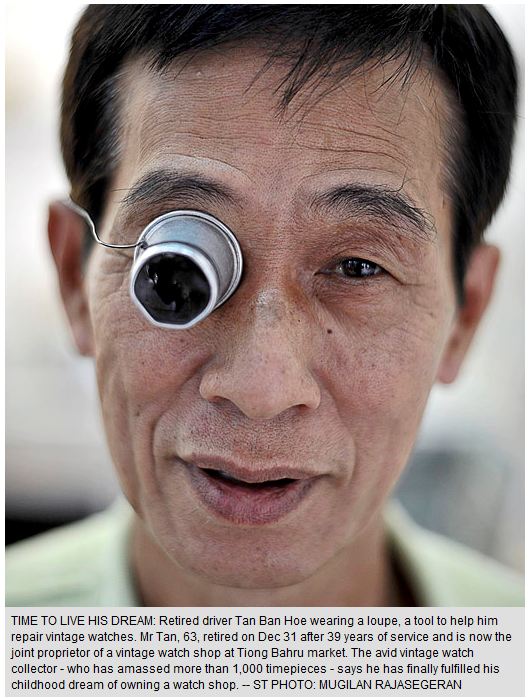
Nick opine that Mr Tan probably has the largest
collection of Ladies mechanical watches in Singapore since most collectors
usually go for the Men's.
So many of Mr Tan's collections are so dainty and small.
I suspect Mr Tan is the reincarnation of the Six Million
Dollar Man with embedded built-in zoom lenses in his eyes and a robotic
precision pair of hands to be able to repair all those minuscule watches.

If Mr Tan is not too busy, you can ask him to show you
his drawers of forgotten glory and memories. (I called it the GRAVEYARD!)
There are so many broken watches in those drawers and he
intends to harvest those for spare parts.
If you are in the hood, do check out this interesting
shop.

Sunday, September 11, 2011
The Straits Times : Keeping alive a vanishing trade
National Heritage Board exhibition to showcase 18 old-style provision shops
The Straits Times
11 September 2011
By Kezia Toh
 |
Mr Goh Wee at his provision shop Hup Seng in Tiong Bahru. He says his customers buy fewer things now than before - a bottle of soft drink, compared with sacks of rice and milk powder in the past. -- ST PHOTO: TERRENCE LIM |
They were a fixture in the old days: pulley tins that provision shop owners used to keep spare change.
These days, however, cash is usually kept under lock and key - a sign of the changing times.
Mr T.T. Lin from Tian Kee provision shop in Dakota Crescent near Mountbatten is one of those who have taken this precaution.
'As more people move in and the usual crowd disappears, the level of trust between neighbours goes down, which is why we need to guard against thieves,' he said.
The 80-year-old has been running his provision store in the sleepy neighbourhood for more than 50 years.
Changes such as these, along with the dwindling number of such neighbourhood shops that were once a familiar sight in any residential landscape, spurred the National Heritage Board (NHB) to embark on a project to document them.
Part of the board's Community Heritage Series, which captures important elements of heartland heritage, the research project will cover 18 old-style provision shops.
They include one established in the late 1920s in Joo Chiat Road and another in the 1930s in Changi Road.
These 18 were chosen because they have remained relatively unchanged over the years.
The project aims to capture this vanishing trade for the next generation of Singaporeans. A travelling exhibition based on archive materials and newspaper reports and featuring photographs and collectibles will go to community clubs, libraries and schools in December.
The Singapore Provision Shops Friendly Association now has fewer than 150 members, compared with about 1,200 in the 1970s.
Customers have deserted them for supermarket chains, convenience stores and minimarts, which offer a greater variety of products and comfort shopping in an air- conditioned environment.
Those who continue to patronise the provision shops buy fewer things, said shop owners.
Said Mr Goh Wee, owner of Hup Seng provision shop in Tiong Bahru: 'Even if I have 100 customers a day, so what? They used to buy sacks of rice and milk powder, but these days, they come in just for a bottle of soft drink. Small things.'
But some still doggedly persist in running their business.
Mr Lin is barely able to cover the cost of his rented space, which is about $1,000 a month. His four children - in their 40s and 50s - also tell him not to labour any more.
But for him, this is not hard work. 'For me, a happy retirement is like this, where I can chat with my neighbours when they come to the store, so that I don't feel lonely,' he said.
Cultural studies academic Liew Kai Khiun, also a committee member of the Singapore Heritage Society, praised NHB's move, but said that it would not help traditional provision shops stay relevant.
'Devoid of their historical functions and contexts, these shops would merely be reduced to tourist and educational exhibits of a bygone era.'
He added that it is more about the spirit of these shops - which foster neighbourliness and community, as compared to more impersonal retail outlets that are homogenising the social landscape.
He has suggested that the Government offer tax incentives and cheaper rent to these shops in the heartland, to keep the culture going.
Former president of the Singapore Heritage Society Kevin Tan is keen for the exhibition to be a family event.
He said: 'Provision shops are a part of community life because it is in the neighbourhood, so families should get together and go, instead of it being a school excursion.'
And most of the time, people treasure only what is disappearing.
'It is like with the KTM railway's closure - people become curious because that sense of loss is more immediate,' he said.
keziatoh@sph.com.sg
___________________________________________________
GUAN HIN PROVISION SHOP
'This trade is dying out'
 |
Guan Hin provision shop in Tiong Bahru, which opened in 1955, is run by Madam Tan and her husband. They used to have 100 customers a day in the 1980s, but their business has halved. -- PHOTO: HAN FEI |
Time seems to have stood still at Guan Hin provision shop in Tiong Bahru.
Cans of food line the floor-to-ceiling wall shelves with sliding glass doors. A vintage Smith electric clock and even a non-working rotary Bakelite telephone sit in a corner of the 56-year-old store.
Owners Ng Heng Lin, 82, and his wife Tan Koy Eng, 74, have seen business slow to a trickle in recent years.
While they used to have 100 customers a day in the 1980s, business has since halved. They can still cover the cost of running the business, since they own the shop space.
So the pair are still clinging on to the shop and do not mind the long hours - the store is open daily from the late afternoon to the wee hours of the morning.
Madam Tan said: 'I will work for as long as I am able to, because staying at home just to eat and sleep is much worse.'
Keeping active is a priority for both, that is why they enjoy the dynamic nature of buying and selling.
But the couple are resigned to the shop shutting its doors for good once they retire. Their three children are university graduates and do not wish to take over.
'I know that young people do not want to take this up because they would want to have their own professional careers, which is why this trade is dying out.'
The Straits Times : The disappearing 'mama shops'
The Straits Times
11 September 2011
By Yuen Sin
Remember the days when you used to pop by the kiosk at your void deck to pick up a quick snack or some groceries?
Such standalone kiosks, affectionately known as 'mama shops' (mama stands for 'Uncle' in Tamil), have weathered the times since they started out as wall stores along shophouses in the 1950s.
Selling sundry goods and traditional sweets, they have been hailed as icons of Singapore's architectural landscape and part of the nation's collective memory.
But like provision shops, these wall stores, too, are fast disappearing.
When they were introduced into housing estates by HDB in the 1980s, they used to dot the precincts as numerously as every fourth block.
At their peak in 1983, there were about 600 such shops. Low demand from prospective operators has resulted in that number dwindling to about 380 kiosks in the past five years.
All 10 stores that The Sunday Times interviewed said it is hard to keep afloat amid rife competition from chain stores.
Mr Sheik Duad, 41, who helps his uncle tend the Faizal & Jahabar Store at Block 175 Toa Payoh Central, said: 'In those days, where can you find a 7-Eleven in the housing estates? They were all available only in the city.'
His store, a stone's throw away from a Cheers outlet and a FairPrice supermarket, has been around for 40 years.
While some have modernised their shops, they are still a class apart from chain stores, which are able to reap economies of scale.
iEcon, for example, started from a group of provision shop owners who banded together to do central purchasing of stock and upgraded to minimarts. It made its mark in heartland neighbourhoods as early as 1982. There are now 100 of such iEcon stores, with 90 per cent operating in HDB estates and three of them in void decks.
7-Eleven entered the heartland in 1984, and about a third of its 550 stores are located in heartland estates, with 3 per cent in void decks.
Cheers, which has over 80 standalone stores, says 35 per cent are located in HDB estates. There are also four void-deck stores.
Another factor is the changing demographics of the old estates where these stores are mostly located in.
At Hoe Peng Kiosk in Shunfu Road, Mr Ong Hoe Peng, 50, said business has been getting worse in the 20 years the store has been around.
He said: 'A lot of my customers used to be neighbourhood kids but now it's mostly old people who live around here.'
Yet, owners staunchly cling on to the model of business that has served them over the years. It is the human touch, they say.
Take Mr Toh Yew Ghee, 41, who has operated a store at Block 222 Toa Payoh Lorong 8 for 13 years. Having interacted with residents there for many years, 'we're now like friends and sometimes they'll joke, call me 'handsome'.'
Delivery services are also available - without additional charges.
Mr Stephen Neo, 47, a senior executive, is also appreciative of the fact that things can be bought on credit.
'I can just grab a drink from the fridge even though I don't have money with me, and the owner will say no problem, pay another day.
'They are friendlier and there is also a sense of trust and closeness.'
Thursday, September 8, 2011
The Straits Times : The business of 'keeping provision shops alive'
NHB project to document heartland culture will cover 18 old-style shops
The Straits Times
8 September 2011
By Kezia Toh
 |
Guan Hin provision shop in Tiong Bahru, which opened in 1955, is run by Madam Tan and her husband. They used to have 100 customers a day in the 1980s, but their business has halved. -- PHOTO: HAN FEI |
The request came from staff of a research firm appointed by the National Heritage Board (NHB), which is documenting this slice of Singaporean life as part of its Community Heritage Series.
The project will cover 18 old-style provision shops, including one established in the late 1920s in Joo Chiat Road and another in the 1930s in Changi Road.
The researchers will also dig into the archives and old newspaper reports, and use information from the Singapore Provision Shops Friendly Association.
Said Mr Alvin Tan, director of heritage institutions and industry development at NHB: 'We want to document our heartland heritage for the future generation of Singaporeans who may not be familiar with this, so that they can relate when their parents share memories from the past.'
Modern-day supermarkets, convenience stores and minimarts are threatening to bring down the shutters on the old operators. One telling fact - the Singapore Provision Shops Friendly Association now has fewer than 150 members, compared with about 1,200 in the 1970s.
Its secretary Tan Bock Heng, 72, used to run a provision shop in Jalan Sultan, but closed it in 1995 when the landlord took over the space.
He said: 'After my generation, traditional provision shops will disappear and we know it. Even if we were to promote ourselves to draw customers, where would we get the funds to do that?'
At one old-time outlet, Guan Hin provision shop in Tiong Bahru, owner Ng Heng Lin, 82, said he and his wife Tan Koy Eng, 74, will continue as long as they can.
They had 100 customers a day in the 1980s, but business has halved since then.
Madam Tan noted that while customers used to buy cans of dried food by the box, they now opt for just a few cans.
Their three children, all university graduates, do not want to take over the shop, which opened in 1955.
NHB plans to curate an exhibition based on the research findings, photographs and collectibles donated by shop owners and the association. The exhibition will be held in community clubs, libraries and schools in December.
keziatoh@sph.com.sg
Saturday, July 30, 2011
Business Times : Tiong Bahru Redux
Designer home offices, indie retail outfits, penthouse parties, a resident stormtrooper... Welcome to Tiong Bahru, where heritage is hip and old-world charm meets edgy entrepreneurship.
Business Times
30 Jul 2011
By Tan Teck Heng
TIONG Bahru resident Lim Kah Hoe is a hardcore Star Wars fan who's game enough to don his stormtrooper uniform on a walk around the neighbourhood.
This masked and costumed figure may be a pretty startling addition to the scenery, but considering the transformation that has swept through the district recently, the sight of a stormtrooper hardly counts as an alien invasion. A walk from Eng Hoon Street to Yong Siak Street today is like visiting a completely different world, thanks to an influx of designer home offices, creative small businesses and indie retail outfits with artsy facades.
Says Mr Lim: 'I like the fact that many new residents and businesses‚ have been moving in; it injects life, and a changing‚ estate is a dynamic one.'

Homegrown comedienne Selena Tan agrees: 'It's really been gentrified, but still has a lovely village feel.' And the Dim Sum Dolly ought to know - she helps out at her mother's Peranakan food stall in Tiong Bahru Market. Daisy's Dream Kitchen sees all sorts of customers daily, from elderly residents to expatriates and yuppies living or working around the area.
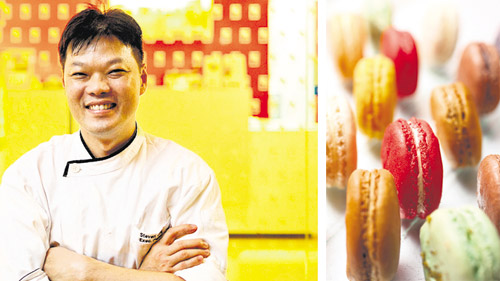
'It's (becoming) an edgy type of place ... a lot of fancy cars around,' says Steven Ong, chef owner of patisserie Centre Ps. The patisserie, started in 2007, was one of the first new wave outfits in the area. Mr Ong notes that the young couples or expatriates who live around the area often turn the upper levels of the neighbourhood into 'penthouse parties'.
One doesn't have to look far for a similar sentiment - Maria Ng, owner of art gallery White Canvas located just next door, concurs. 'Because of the low-density and the conservation efforts, the older population has moved out,' she says.
'You get the younger people and expatriates moving in who are sure of what they want - those who don't want to live in a box or high up in sky - and many of their homes are designer types which have been featured in magazines.'
It was quite a different story five years ago. Says Mr Lim, who owns a studio apartment: 'Back then, with the shabbiness that was associated with the area, many were not keen about moving into this place at all.'
But he took the plunge, and is probably very glad he did. Since then, property prices have doubled, says Centre Ps's Mr Ong. A conservation site since December 2003, Tiong Bahru today sees tidy streets lined with refurbished, freshly painted shophouses. Many ground level units sport fancy, contemporary facades with sleek, modern lines.
One such unit along Yong Siak Street houses creative studio Tofu, started in March. Says creative director Michelle Au: 'We really like the old and new energies together, (with) new talents and shops sprouting up among old historical buildings.'
The shops Ms Au is referring to include the holy trinity of coffee joint 40 Hands, bookstore BooksActually and artisan boutique Strangelets, all located just next door to each other. After 40 Hands opened in October last year to rave reviews, the latter two outfits were persuaded to shift from their previous locations in Chinatown.
For many, the old-world charm and serenity of the district is the biggest draw. 'We find the old Tiong Bahru neighbourhood incredibly charming with its interesting mix of old architecture and an up-and-coming arts scene,' says co-owner of Strangelets, Ong Ker Shing.
And for them, creativity is not the only thing that's hitting an all-time high; business is better, with both Strangelets and BooksActually reporting growing sales figures.
It explains why the surrounding businesses are not content to rest on their laurels. Management consultancy firm Ampern Services moved in last year, diversifying from its core business with a new concept retail store and art gallery named Bhutan Shop. The current floor space is divided into two by a lounge/gallery area, with Ampern's office at the back.
The retail outfit sells products from Bhutan which are organic, eco- and social-friendly. Director Ong Eng Chin hopes to see 30 per cent of his overall revenue coming from Bhutan Shop in the future.
White Canvas's Ms Ng has also started up what she calls an 'art cafe' just down the street from her already established gallery. Named The Orange Thimble, it features artworks related to the neighbourhood. There are also quaint decor elements in the form of refurbished antique furniture and novelty accessories - reassuring residents who may be concerned about the rapid evolution of the district that they can have their cake and eat it too.
'There are many zi char restaurants here, and people do come here for the food,' observes Ms Ng, who notes that there are also many visitors who come for more plebeian pursuits. 'You can't compete with that - the idea here is to complement them.' So newer establishments should offer a place where one can have 'a cup of coffee in an air-conditioned place ... or (food) for the health-conscious, like sandwiches', she says.
That is exactly what the minds behind 40 Hands - beauty and F&B brand Spa Esprit - intend to do. Come late September, they will open a new casual dining restaurant named Open Door Policy (OPD). The menu will be designed by Ryan Clift, co-founder and executive chef of Tippling Club at Dempsey.
'The appearance of 40 Hands has changed the landscape of Tiong Bahru, turning it into a bustling and much talked about area,' says founder Cynthia Chua. 'With that endorsement, we are stoked to launch another creative F&B concept to further boost the scene.'
Despite the surge in development, there are obstacles halting the rate of growth. 'The commercial units (in the area) are not easy to come by, and there are very few of them,' says Ms Ng, who has had trouble getting a unit for her art cafe which is closer to White Canvas. She adds that the Housing Development Board (HDB) has been increasingly reluctant to give out cooking licences, apparently because of noise complaints from residents.
But Tofu's Ms Au feels that controlling the number of businesses here is a good thing. 'This helps ensure that the residents don't get crowded out, and that the vibe remains peaceful and laid back - we love that.'
She adds: 'I hope ... it doesn't get overly commercial or pretentious. After all, what makes this area charming is the authenticity of the old businesses and residents.'
Still, tenants remain confident that their vision of Tiong Bahru turning into an indie hangout will come to fruition.
'We think Tiong Bahru will continue to grow in popularity - its laid-back, chilled-out vibe appeals to those looking to escape the crowded and heavily-commercialised parts of Singapore,' says Strangelet's Ms Ong.
And you can't buy heritage. 'There are pre-war HDB buildings here; I don't think you can find it anywhere in Singapore ... there's a lot of historical value,' adds Centre Ps's Mr Ong.
Concludes stormtrooper Mr Lim: 'Tiong Bahru is certainly evolving, and I definitely think its headed in a nice direction - it has a certain chaotic, yet natural beauty.'
BooksActually
9 Yong Siak Street
Tel: 6222-9195
booksactually.com
FIRST, it was part of an independent retail movement in Club Street that turned the Chinatown neighbourhood into a gentrified lifestyle hotspot. Now, BooksActually has joined other independent operators who are doing the same in Tiong Bahru.
Moving in three months ago, owners Karen Wai and Kenny Leck were convinced by their friend Harry Grover, who started the popular coffee joint 40 Hands just across from them on Yong Siak Street.
The relocation is friendlier on their bank books too. 'Rent-wise, we are paying less than half of that in Club Street,' says Ms Wai, who says it was the main reason for their move. 'It's hard to find a nice location that's rather central, but which has ample parking.'
While their subsidiary brand Birds & Co - which retails hand-made stationery and vintage novelty items - has two outlets in Tangs and Cineleisure Orchard, the owners have no intention of shifting their flagship store to the heart of town. Nor are there plans to open branches of the bookstore, as the whole idea is to retain an intimate connection with hippie book lovers.
The shift has in fact done just that, with results exceeding the owners' expectations, and the neighbourhood is proving to be just the right fit for indie establishments.
'People living here are mostly PMEBs and expatriates - people with higher income brackets,' says Ms Wai. 'They are more supportive of independent startups,' she continues, adding that business has increased significantly since the shift.
As the current store is also slightly larger and consolidated into one single level (compared to the two-level space at Club Street)), there's more leeway to host larger events. Hence, the outfit has fired up its efforts to galvanise the local literary scene.
One new initiation is Babette's Feast, a fortnightly gathering where writers new or experienced can 'come and share their own works, and talk about writing with people from the writing industry,' says Ms Wai.
The sessions will culminate in a series of chapbooks - short books - which will be distributed by their in-house publishing press, Math Paper Press.
Bhutan Shop
1D Yong Siak Street
Tel: 6236-0750
FOR a country obsessed with rankings, Singapore has done remarkably badly in indices measuring happiness.
So perhaps it's time to take an interest in Bhutan, the land from which the concept of 'Gross National Happiness' originated. If you can't find Bhutan on the map (hint: it's a Himalayan nation), the best place to learn about it here will be at Bhutan Shop, tucked away in a corner of Yong Siak Street.
Started in March by a group of friends, the retail outfit specialises in all things Bhutan-related. It's also the local representative of two Bhutanese tour agencies, so it really is a one-stop shop.
A lounge and gallery area features works by Bhutan artists (priced between $800 and $12,800). In addition, there are organic products from Bhutan and Thailand. The eco-conscious will love the 100 per cent organic 'soap nuts', or nature's own detergent, which are purportedly suitable for people with sensitive skin. There's also honey, handmade cashmere bags, organic herbal teas, and a range of lemongrass fragrances and essential oils which can act as insect repellents.
Featuring Bhutanese culture as an integral theme of the retail outfit was, shall we say, an equally organic decision.
'We have good connections with Bhutanese business associates and friends,' says store manager Tan Tiong Pin, adding that interest in Bhutan has skyrocketed since Hong Kong celebrities Tony Leung and Carina Lau had their wedding there.
Speaking of weddings, the shop will host its debut cultural exhibition in October - in line with Bhutan's royal wedding. Bhutanese contemporary art, wedding culture and traditional costumes will be displayed, and visitors will get a chance to sample Bhutanese fare as well. The centrepiece of the exhibition will be Bhutanese artist Dorji Gyeltshen's painting Kilkhor, which is an abstract representation of 'four boundless thoughts: loving-kindness, compassion, sympathy and equanimity', says Ms Tan.
If happiness can indeed be bought, perhaps it'll be found amidst the 'green' esoteric offerings of Bhutan Shop. But whatever form it takes, it'll probably involve a fair bit of tree-hugging, social causes and healthy living.
Strangelets
7 Yong Siak Street
Tel: 6222-1456
'A STRANGELET is a theoretical particle that converts any other particle it touches into a Strangelet as well,' explains co-founder of the outfit, Ong Ker Shing.
It makes 'Strangelets' a doubly apt name for an artisan's boutique located along Yong Siak Street. Because while Strangelets may have meant to make waves by converting the way people shop ('It's not all about brand recognition,' says Ms Ong), it's also one of a handful of independent startups along Tiong Bahru - and like its namesake, the outfit is creating a ripple-like effect with the area morphing into an artsy hangout.
The chemistry started with a passion for design, and a love of 'handcrafted objects or the intelligence and simplistic beauty in design items,' says Ms Ong.
So along with husband Josh Comaroff, friend Schirin Taraz-Breinholt (all architects) and investment banker Yeo Wenxian, the group of four started the brand in mid-2008 on Amoy Street, and moved to their current location in June this year.
The shift was 'driven by a desire for change,' says Ms Ong, and the group was drawn to the area due to the presence of indie bookstore BooksActually as well as coffee joint 40 Hands.
'In a way, all three of us appeal to the indie crowd,' says Ms Ong. 'When the unit next to them became available, we jumped at the opportunity to be side-by-side as we complement each other'.
Business has been brisk at the location, and the 'small boutique experience' they offer (inspired by Greenwich Village in the Big Apple) is a hit. Their curated items form an eclectic selection, ranging from American retro cardholders by Postalco ($185) to white glazed ceramic tableware and titanium plated cutlery by Astier de Villatte ($30-300), and there's stationery and jewellery too. So it's little wonder that they're attracting everyone from the indie crowd to working professionals and tai-tais.
'For us, Strangelets is a fun mix between hobby and enterprise,' Ms Ong says. 'We wanted a diversion from the tedium of the mass market shopping scene in Singapore.'
The Orange Thimble
Blk 56 Eng Hoon Street #01-68
Tel: 6223-8068
http://www.theorangethimble.com/
THERE'S a schizophrenic air about Tiong Bahru which adds to its charm factor - a heartland district with low-rise flats dating back to the 1950s, dotted with artsy, indie startups in refurbished shophouses co-existing with old-fashioned provision shops.
Offering a mix of old and new is The Orange Thimble, opened just this week by Maria Ng who also owns art gallery White Canvas. The cafe is located just down the street from the gallery, and features works from artists (both local and foreign) with whom White Canvas has built relationships. Many of the works are also Tiong Bahru-themed and include paintings by Tia Boon Sim, once a student of the late homegrown artist Liu Kang.
Ms Ng took great pains to preserve the shophouse which she has transformed into a quaint hangout where art meets F&B. The collapsible grille and folding doors were kept, and a cast-iron window frame was refurbished and installed. The decor also includes an antique cash register, a safe, and Chinese stools given to her by Tiong Bahru residents.
There's even a wooden menu hung on the wall, poached from a traditional coffee shop - but of course The Orange Thimble doesn't serve soft boiled eggs or kaya toast. On the menu instead are gourmet sandwiches and coffee, shepherd's pie, and a range of desserts, including ice cream.
'We wanted to remember the past,' says Ms Ng of the design concept, and in fact, the reference to the thimble is in honour of the previous owner who was a seamstress. The premises have, however, been updated with a vibrant coat of Tuscan orange paint, and the alleyway is in the middle of being converted into an industrial-chic al fresco area with a trellis and an exposed brick wall.
'My business partner and I travel a lot and enjoy coffee,' says Ms Ng, who's had her palate refined by visits to cafes and restaurants in cities such as Paris and London. So while they wish to bring the experience of chilling at a mom-and-pop cafe to the district, 'we (also) want to honour and preserve the heritage of Tiong Bahru', she concludes.
thtan@sph.com.sg
Copyright © 2010 Singapore Press Holdings Ltd. All rights reserved.
Business Times
30 Jul 2011
By Tan Teck Heng
 |
| AND LIFE GOES ON Unfazed by the arrival of a younger, hipper crowd, the original residents of Tiong Bahru continue to gather for chats downstairs, or watch the world go by from their upstairs windows |
This masked and costumed figure may be a pretty startling addition to the scenery, but considering the transformation that has swept through the district recently, the sight of a stormtrooper hardly counts as an alien invasion. A walk from Eng Hoon Street to Yong Siak Street today is like visiting a completely different world, thanks to an influx of designer home offices, creative small businesses and indie retail outfits with artsy facades.
Says Mr Lim: 'I like the fact that many new residents and businesses‚ have been moving in; it injects life, and a changing‚ estate is a dynamic one.'

Homegrown comedienne Selena Tan agrees: 'It's really been gentrified, but still has a lovely village feel.' And the Dim Sum Dolly ought to know - she helps out at her mother's Peranakan food stall in Tiong Bahru Market. Daisy's Dream Kitchen sees all sorts of customers daily, from elderly residents to expatriates and yuppies living or working around the area.
 |
| QUICK BITES Daisy Tan (left) flanked by her children Selena, the local comedienne, and Ray. Mrs Tan's Peranakan food stall in Tiong Bahru Market, Daisy's Dream Kitchen, sees all sorts of customers, from elderly residents to expatriates and yuppies living or working around the area. |
 |
|
'You get the younger people and expatriates moving in who are sure of what they want - those who don't want to live in a box or high up in sky - and many of their homes are designer types which have been featured in magazines.'
It was quite a different story five years ago. Says Mr Lim, who owns a studio apartment: 'Back then, with the shabbiness that was associated with the area, many were not keen about moving into this place at all.'
 |
| COLOURFUL CHARACTERS Stormtrooper Lim checking out the upholstery shop behind his apartment. Above right: Maria Ng, owner of art gallery White Canvas and art cafe The Orange Thimble |
But he took the plunge, and is probably very glad he did. Since then, property prices have doubled, says Centre Ps's Mr Ong. A conservation site since December 2003, Tiong Bahru today sees tidy streets lined with refurbished, freshly painted shophouses. Many ground level units sport fancy, contemporary facades with sleek, modern lines.
One such unit along Yong Siak Street houses creative studio Tofu, started in March. Says creative director Michelle Au: 'We really like the old and new energies together, (with) new talents and shops sprouting up among old historical buildings.'
The shops Ms Au is referring to include the holy trinity of coffee joint 40 Hands, bookstore BooksActually and artisan boutique Strangelets, all located just next door to each other. After 40 Hands opened in October last year to rave reviews, the latter two outfits were persuaded to shift from their previous locations in Chinatown.
For many, the old-world charm and serenity of the district is the biggest draw. 'We find the old Tiong Bahru neighbourhood incredibly charming with its interesting mix of old architecture and an up-and-coming arts scene,' says co-owner of Strangelets, Ong Ker Shing.
And for them, creativity is not the only thing that's hitting an all-time high; business is better, with both Strangelets and BooksActually reporting growing sales figures.
It explains why the surrounding businesses are not content to rest on their laurels. Management consultancy firm Ampern Services moved in last year, diversifying from its core business with a new concept retail store and art gallery named Bhutan Shop. The current floor space is divided into two by a lounge/gallery area, with Ampern's office at the back.
The retail outfit sells products from Bhutan which are organic, eco- and social-friendly. Director Ong Eng Chin hopes to see 30 per cent of his overall revenue coming from Bhutan Shop in the future.
White Canvas's Ms Ng has also started up what she calls an 'art cafe' just down the street from her already established gallery. Named The Orange Thimble, it features artworks related to the neighbourhood. There are also quaint decor elements in the form of refurbished antique furniture and novelty accessories - reassuring residents who may be concerned about the rapid evolution of the district that they can have their cake and eat it too.
'There are many zi char restaurants here, and people do come here for the food,' observes Ms Ng, who notes that there are also many visitors who come for more plebeian pursuits. 'You can't compete with that - the idea here is to complement them.' So newer establishments should offer a place where one can have 'a cup of coffee in an air-conditioned place ... or (food) for the health-conscious, like sandwiches', she says.
That is exactly what the minds behind 40 Hands - beauty and F&B brand Spa Esprit - intend to do. Come late September, they will open a new casual dining restaurant named Open Door Policy (OPD). The menu will be designed by Ryan Clift, co-founder and executive chef of Tippling Club at Dempsey.
'The appearance of 40 Hands has changed the landscape of Tiong Bahru, turning it into a bustling and much talked about area,' says founder Cynthia Chua. 'With that endorsement, we are stoked to launch another creative F&B concept to further boost the scene.'
Despite the surge in development, there are obstacles halting the rate of growth. 'The commercial units (in the area) are not easy to come by, and there are very few of them,' says Ms Ng, who has had trouble getting a unit for her art cafe which is closer to White Canvas. She adds that the Housing Development Board (HDB) has been increasingly reluctant to give out cooking licences, apparently because of noise complaints from residents.
But Tofu's Ms Au feels that controlling the number of businesses here is a good thing. 'This helps ensure that the residents don't get crowded out, and that the vibe remains peaceful and laid back - we love that.'
She adds: 'I hope ... it doesn't get overly commercial or pretentious. After all, what makes this area charming is the authenticity of the old businesses and residents.'
Still, tenants remain confident that their vision of Tiong Bahru turning into an indie hangout will come to fruition.
'We think Tiong Bahru will continue to grow in popularity - its laid-back, chilled-out vibe appeals to those looking to escape the crowded and heavily-commercialised parts of Singapore,' says Strangelet's Ms Ong.
And you can't buy heritage. 'There are pre-war HDB buildings here; I don't think you can find it anywhere in Singapore ... there's a lot of historical value,' adds Centre Ps's Mr Ong.
Concludes stormtrooper Mr Lim: 'Tiong Bahru is certainly evolving, and I definitely think its headed in a nice direction - it has a certain chaotic, yet natural beauty.'
 |
| THE RIGHT FIT Business at BooksActually has increased significantly since it moved from Club Street to its Tiong Bahru premises (above right). Above left: Sara Tan and Peter Ng of Bhutan Shop get all dressed up for the occasion |
9 Yong Siak Street
Tel: 6222-9195
booksactually.com
FIRST, it was part of an independent retail movement in Club Street that turned the Chinatown neighbourhood into a gentrified lifestyle hotspot. Now, BooksActually has joined other independent operators who are doing the same in Tiong Bahru.
Moving in three months ago, owners Karen Wai and Kenny Leck were convinced by their friend Harry Grover, who started the popular coffee joint 40 Hands just across from them on Yong Siak Street.
The relocation is friendlier on their bank books too. 'Rent-wise, we are paying less than half of that in Club Street,' says Ms Wai, who says it was the main reason for their move. 'It's hard to find a nice location that's rather central, but which has ample parking.'
While their subsidiary brand Birds & Co - which retails hand-made stationery and vintage novelty items - has two outlets in Tangs and Cineleisure Orchard, the owners have no intention of shifting their flagship store to the heart of town. Nor are there plans to open branches of the bookstore, as the whole idea is to retain an intimate connection with hippie book lovers.
The shift has in fact done just that, with results exceeding the owners' expectations, and the neighbourhood is proving to be just the right fit for indie establishments.
'People living here are mostly PMEBs and expatriates - people with higher income brackets,' says Ms Wai. 'They are more supportive of independent startups,' she continues, adding that business has increased significantly since the shift.
As the current store is also slightly larger and consolidated into one single level (compared to the two-level space at Club Street)), there's more leeway to host larger events. Hence, the outfit has fired up its efforts to galvanise the local literary scene.
One new initiation is Babette's Feast, a fortnightly gathering where writers new or experienced can 'come and share their own works, and talk about writing with people from the writing industry,' says Ms Wai.
The sessions will culminate in a series of chapbooks - short books - which will be distributed by their in-house publishing press, Math Paper Press.
Bhutan Shop
1D Yong Siak Street
Tel: 6236-0750
FOR a country obsessed with rankings, Singapore has done remarkably badly in indices measuring happiness.
So perhaps it's time to take an interest in Bhutan, the land from which the concept of 'Gross National Happiness' originated. If you can't find Bhutan on the map (hint: it's a Himalayan nation), the best place to learn about it here will be at Bhutan Shop, tucked away in a corner of Yong Siak Street.
Started in March by a group of friends, the retail outfit specialises in all things Bhutan-related. It's also the local representative of two Bhutanese tour agencies, so it really is a one-stop shop.
A lounge and gallery area features works by Bhutan artists (priced between $800 and $12,800). In addition, there are organic products from Bhutan and Thailand. The eco-conscious will love the 100 per cent organic 'soap nuts', or nature's own detergent, which are purportedly suitable for people with sensitive skin. There's also honey, handmade cashmere bags, organic herbal teas, and a range of lemongrass fragrances and essential oils which can act as insect repellents.
Featuring Bhutanese culture as an integral theme of the retail outfit was, shall we say, an equally organic decision.
'We have good connections with Bhutanese business associates and friends,' says store manager Tan Tiong Pin, adding that interest in Bhutan has skyrocketed since Hong Kong celebrities Tony Leung and Carina Lau had their wedding there.
Speaking of weddings, the shop will host its debut cultural exhibition in October - in line with Bhutan's royal wedding. Bhutanese contemporary art, wedding culture and traditional costumes will be displayed, and visitors will get a chance to sample Bhutanese fare as well. The centrepiece of the exhibition will be Bhutanese artist Dorji Gyeltshen's painting Kilkhor, which is an abstract representation of 'four boundless thoughts: loving-kindness, compassion, sympathy and equanimity', says Ms Tan.
If happiness can indeed be bought, perhaps it'll be found amidst the 'green' esoteric offerings of Bhutan Shop. But whatever form it takes, it'll probably involve a fair bit of tree-hugging, social causes and healthy living.
 |
| EYE FOR DESIGN Ong Ker Shing (above left) of Strangelets, an artisan's boutique inspired by Greenwich Village in the Big Apple. Curated items (above right) range from retro cardholders to jewellery |
7 Yong Siak Street
Tel: 6222-1456
'A STRANGELET is a theoretical particle that converts any other particle it touches into a Strangelet as well,' explains co-founder of the outfit, Ong Ker Shing.
It makes 'Strangelets' a doubly apt name for an artisan's boutique located along Yong Siak Street. Because while Strangelets may have meant to make waves by converting the way people shop ('It's not all about brand recognition,' says Ms Ong), it's also one of a handful of independent startups along Tiong Bahru - and like its namesake, the outfit is creating a ripple-like effect with the area morphing into an artsy hangout.
The chemistry started with a passion for design, and a love of 'handcrafted objects or the intelligence and simplistic beauty in design items,' says Ms Ong.
So along with husband Josh Comaroff, friend Schirin Taraz-Breinholt (all architects) and investment banker Yeo Wenxian, the group of four started the brand in mid-2008 on Amoy Street, and moved to their current location in June this year.
The shift was 'driven by a desire for change,' says Ms Ong, and the group was drawn to the area due to the presence of indie bookstore BooksActually as well as coffee joint 40 Hands.
'In a way, all three of us appeal to the indie crowd,' says Ms Ong. 'When the unit next to them became available, we jumped at the opportunity to be side-by-side as we complement each other'.
Business has been brisk at the location, and the 'small boutique experience' they offer (inspired by Greenwich Village in the Big Apple) is a hit. Their curated items form an eclectic selection, ranging from American retro cardholders by Postalco ($185) to white glazed ceramic tableware and titanium plated cutlery by Astier de Villatte ($30-300), and there's stationery and jewellery too. So it's little wonder that they're attracting everyone from the indie crowd to working professionals and tai-tais.
'For us, Strangelets is a fun mix between hobby and enterprise,' Ms Ong says. 'We wanted a diversion from the tedium of the mass market shopping scene in Singapore.'
 |
| WHERE ART MEETS F&B The Orange Thimble is a happy mix of old and new, serving gourmet sandwiches in a refurbished shophouse (above left) |
Blk 56 Eng Hoon Street #01-68
Tel: 6223-8068
http://www.theorangethimble.com/
THERE'S a schizophrenic air about Tiong Bahru which adds to its charm factor - a heartland district with low-rise flats dating back to the 1950s, dotted with artsy, indie startups in refurbished shophouses co-existing with old-fashioned provision shops.
Offering a mix of old and new is The Orange Thimble, opened just this week by Maria Ng who also owns art gallery White Canvas. The cafe is located just down the street from the gallery, and features works from artists (both local and foreign) with whom White Canvas has built relationships. Many of the works are also Tiong Bahru-themed and include paintings by Tia Boon Sim, once a student of the late homegrown artist Liu Kang.
Ms Ng took great pains to preserve the shophouse which she has transformed into a quaint hangout where art meets F&B. The collapsible grille and folding doors were kept, and a cast-iron window frame was refurbished and installed. The decor also includes an antique cash register, a safe, and Chinese stools given to her by Tiong Bahru residents.
There's even a wooden menu hung on the wall, poached from a traditional coffee shop - but of course The Orange Thimble doesn't serve soft boiled eggs or kaya toast. On the menu instead are gourmet sandwiches and coffee, shepherd's pie, and a range of desserts, including ice cream.
'We wanted to remember the past,' says Ms Ng of the design concept, and in fact, the reference to the thimble is in honour of the previous owner who was a seamstress. The premises have, however, been updated with a vibrant coat of Tuscan orange paint, and the alleyway is in the middle of being converted into an industrial-chic al fresco area with a trellis and an exposed brick wall.
'My business partner and I travel a lot and enjoy coffee,' says Ms Ng, who's had her palate refined by visits to cafes and restaurants in cities such as Paris and London. So while they wish to bring the experience of chilling at a mom-and-pop cafe to the district, 'we (also) want to honour and preserve the heritage of Tiong Bahru', she concludes.
thtan@sph.com.sg
Copyright © 2010 Singapore Press Holdings Ltd. All rights reserved.
Subscribe to:
Posts (Atom)