Saturday, February 21, 2009

Tiong Bahru Post War Flats

The Straits Times
Life!
February 21, 2009


The bedrooms' walnut veneer-and- black metal doors use tree branches for handles.

Black and woody

Instead of being gloomy, this flat's black decor gets a warm update with woody and colourful touches

When Jermaine Ng received the key to her resale three-room flat in Tiong Bahru, she could not decide on a style for her new home.

So she based her starting inspiration on the things she likes.

'I love black, and on my travels, the things that attract me are prints and graphics,' says the interior director of design firm Juxtapose.

'Along the way, I found that the natural grain of wood goes with all that.'

Her 1,000 sq ft home is now an eclectic mix of trendy black furnishings, walnut veneer carpentry and funky memorabilia.

Playing with light, she elevated her favourite colour from being a stark, gloomy shade.

In the kitchen, for instance, both matte and glossy textures are used - from shiny black mosaic tiles to a rough flame-finished black granite bar countertop - while walnut veneer cabinet doors provide a soft, warm element.

Evidence of her fun-loving personality is seen on the black powder-coated metal shelves in the living room, where she displays her vintage cameras, drink bottles and matchboxes from around the world.

Designed for entertaining, the roomy living area has a digital turntable on customised roller shelves for spinning tunes and a TV projector set-up for film screenings.

The large projector screen is also a treat for the movie buff, who watches DVDs on quiet nights in with her three dogs.

The previous owner had removed the original balcony and expanded the two bedrooms and a little of the living room before Ms Ng took over the flat two years ago.

'The house with the tree' So structurally, all she had to do was to remove the kitchen wall and reposition one of the bedroom doors for a cleaner layout.

Ms Ng, who likes to cook, wanted plenty of natural light in her kitchen.

With the kitchen wall gone, she now has a bright, breezy space with cross-ventilation from the living room and kitchen windows.

She was also keen to keep the look 'raw'.

So cement walls, grey homogeneous floor tiles and a sinewy tree trunk draped with bulbs and wires in the living room add an organic feel.

'My neighbours know this as 'the house with the tree',' she chuckles and adds that the tree can be seen from the opposite block.

The bedroom, however, takes on a different vibe.

Inspired by the old-world glamour of Hong Kong film-maker Wong Kar Wai's movie In The Mood For Love, Ms Ng went with a black-and-red palette with strong Oriental elements, including a headboard wrapped in a vermillion chinoiserie fabric from Belgium.

To evoke the movie's sultry vibe, she painted the walls rust-red and used black glass sliding doors for the full-height wardrobe.

Black may seem like the worst colour to have for a home owner with three white dogs, but for Ms Ng, it is not an issue.

'Black is hard to maintain but I'm not particular about the mess.'

Besides, the timber flooring was dark-stained for a good reason.

'So I won't trip over my white dogs in the dark room,' she quips.

A black glass panel with sandblasted engraving by the main door acts as a doormat and leads to a tree trunk decor piece in the living room (above).
-- PHOTOS: DARREN CHANG; ART DIRECTION: NONIE CHEN; TEXT: WYN-LYN TAN

This spread first appeared in the February issue of Home & Decor, published by SPH Magazines.

Friday, February 20, 2009

Good Neighbours

This post is a follow up on my previous post, “Incompatible Policies”.

Reading the Electronic Version of
The New Paper today made me wonder if the fight was a result of overcrowding.

Within the paper, there was also an
article about Singaporeans who cares for the foreign workers

The Straits Times also reported that the Worker’s Dormitory at Serangoon Gardens will be ready in August this year.

This is good news as I always felt that we need to give proper considerations to these migrant workers’ welfare.

These migrant workers left their comfort zone, family and familiar surroundings to come here to find work so as to ensure a better future for their family.

It was the same motivation that prompted our forefathers to come to Singapore less than a century ago.

These workers are necessary for our country as they help lubricant the economy so that Singaporeans can continue to pursue the good life that they all enjoy.

Thus, it is not fair to “sardine” them into cramp places and still expect them to deliver tip top services with flawless attitude.

I cringe whenever I hear people complaining about these groups of people who cannot speak English and so on and so forth.

If you see beyond the language and cultural differences, you may discover tenacity, determination, diligence as well as contentment within them.

If you were to dump me in Spain today, I will probably not survive for too long due to the language difference. These migrant’s ability to assimilate quickly into a new environment is commendable.

I sometimes wondered if the Singapore Machinery has made me soft.

If these people are expected to deliver the highest service level with the best attitude, I think their place of rest should be decent too.

These human beings are not the vacuum cleaners in our homes where after using it, we put it in the store room.

Sure, there will be some discomfort in living next to them. This is due to a lack of understanding and some irrational fear or prejudice.

I’m sure the when the Chinese flooded Australia, the “Natives” there were upset.

A few decades had gone by and I think there is a better level of acceptance and integration over in Australia now.

I can accept the fact that some of these apartments may be turned into affordable lodging for this group of people but I cannot accept overcrowding.

And I know the term “OVERCROWDING” has different meaning to different people.

I just hope it will not become an excuse that will be used blindly and unwittingly kill off someone’s dream and aspirations.

We do not need people to conform to our culture as we welcome diversity.

But I think common sense should prevail when it comes to “neighbourliness”.

The key words are RESPECT & TOLERANCE here (Love Your Neighbour as you would yourself)

If people are more respectful here, they will think twice before they dump the rubbish inconsiderately, they will lower the volume of their home entertainment system at night, they will clean up after their dogs, they will not feed the cats with leftover food which cockroaches also thrive in, they will not chain up their bicycle indiscriminately along the walkways......blah blah blah.

Once we get everyone to be more respectful & more tolerant about differences, Tiong Bahru will become an even better place to live in.

I will end off with this song I found from YouTube. We all know the words but the tune is not exactly familiar.

If we have an open mind, we should be able to enjoy this song but if that is not our cup of tea, perhaps we can also tolerate it and let people who enjoy it enjoy.


Thursday, February 19, 2009

Getting Red over Green

I've been putting off the opportunity to blog about those recycling initiatives we have here at the Tiong Bahru Estate.

I think this is an initiative that induces a love-hate mental state amongst residents here.

We all know by now that we need to Reduce, Reuse and Recycle. I support that!


But deep down, I hate the way recycling is done over here!

Something happened yesterday made me snap!

No, it wasn't because
SULO moved the recycling bins from between block 48 and block 50 Moh Guan Terrace to block 38 Kim Pong Road.


The bins used to be located in between block 50 & block 48 Moh Guan Terrace

It was the lack of "engagement" that cheesed me off the most!

When I saw the recycling bins in front of block 38 Kim Pong Road, my initial thoughts was why did they not placed the bins next to the rubbish collection centre.


The bins are now located in front of block 38 Kim Pong Road

Why place it here to create so many pockets of messiness within this housing estate?

So I decided to call the hotline to find out if I can get them to move the bins to a more suitable location.

The 1st call to SULO was straightforward enough.

The male voice told me Lawrence and Ismail are in charge of this area and I should call them to find out.

He also said that I should contact Ismail first since Ismail is the manager.

I called Ismail’s number and was told that he was out of the office.

So I asked if I could speak to someone else instead and that lady connected me to another lady.

Since I was always curious about how often SULO clear these recycling bins, I decided to ask this nagging question that I have before suggesting to them about moving the bins.

It was a straightforward question which requires a straightforward answer.

The lady couldn’t answer it and I was put on hold to listen to some music.

When someone seems to be back on the line and before I could utter anything, I was put on hold to listen to the music again!

This pick-up, put-on-hold process was repeated about 3 times and then the line seems to go quiet.

Thinking that the line was dropped, I starting grumbling about how they have dropped my call after making me wait for so long.

To my embarrassment, a voice suddenly came back on to ask me for my contact number so that SULO can get back to me with an answer. (I think she heard my grumbling and the words I used wasn't pleasant.)

Me: What do you mean you need to check? You mean you don't even know how often you clear the bins?

SULO: I need to check with the person who is in charge, I don't know!

Me: Never mind then, I will call Lawrence to find out…since I have his number.

When I called Lawrence, he appeared a bit annoyed with me and asked me where I was calling from.

After I told him I was calling from Tiong Bahru, he asked me to call another number.

I went ballistic from here onward!

Me: What’s wrong with you guys? I just wanted to know how often you clear the bins. And you have to push me around your organization to get this simple answer?!

Me: Isn't that supposed to be common knowledge? Don't you even know how often bins in Tiong Bahru are cleared?!

Lawrence: I will check and call you back.

Eventually, Lawrence returned my call and by then, I have calmed down.

Lawrence: The bins in Tiong Bahru are cleared every Wednesday… but my men have already cleared the bins yesterday!

Me: Okay, Thanks. Do you think I could suggest you move the bins to the side of the rubbish collection centre?

Lawrence: I cannot decide because all these issues are decided by the NEA. They gave instruction to move those bins from block 50 Moh Guan Terrace to somewhere else.

Lawrence: You have to call them to find out.

(During our conversation, Lawrence also insisted that these bins are not mosquitoes incubators as the bins are kept closed all the time and water can flow out of the bins from the holes below!

Doesn’t he know that there is an orange cover which you can open up to throw your stuff in? And if the bins are filled to the brim, these cover will be left in the open mode. The contents within the bin can also trap water, making it conducive for the mosquitoes to breed. Perhaps someone has to contract dengue before action will be taken….oh sorry, make it MANY MANY people have to contact it because 1 person doesn’t make this area a hot spot and so no action will be taken either.)

Since I was out for the day, I had to Google NEA on my phone to get the number. (I really wanted to resolve this matter ASAP)

The call to NEA was surprising efficient, within 3 rings, someone answered my call.

The female voice at the end of the line took all my details and information and say she will escalate this!

Escalate? Mmm, I know the word “escalate” is used quite liberally in the corporate world but somehow she made it sound like I'm a trouble maker here.

So now I will wait for her to escalate this request.

While I wait for NEA’s reply, here’re some pictures to describe what I meant:


Move the bins to the side of the rubbish collection centre.

Here’s how it would look like

Personally, I don't really like the recycling bins because the collections is too few and far in between, resulting in a lot of pilferages.

I will use picture to illustrate my point:

Some stuff is placed into the bin while some are placed near the bins. As long as they are neat and tidy, it is acceptable.

People pilfer them for their own gains

This is the resulting mess and this scene is repeated all over Tiong Bahru!

How could we live with all these mess?

We have to decide if we should give priority to the green movement or give priority to a beautiful estate.

I suggest SULO come and clear these “GREEN MINE” more often so that everyone wins.

(If you think I complained too much lately, here’s a video that was inspired by a complaining spirit.)


Wednesday, February 18, 2009

Incompatible Polices

Artwork by Ward Jenkins , Portland, Oregon, United States

As I read about 2 recent newspaper articles about Singapore having her own World Heritage Site and about how Singapore progressed rapidly from slums to a world class city, I cannot help but feel that the demographics of the Tiong Bahru Estate will be changed within the next 5 years due to some incompatible policies.

Demographics – Then and Now
Before MAS relaxed the rules in July 2005 to allow banks to increase their loan quantum to 90% as well as allow CPF members to use their funds for financing properties with short leases, Tiong Bahru was a rather forgotten place.

The only thing worth coming for a visit is probably Seng Poh Market (now known as Tiong Bahru Market).

It was tough to offload or acquire properties here. You either have to sell it very cheaply or you have a find a very CASH RICH buyer.

So what was the scenario at that time?

While waiting for that elusive buyer to appear, most landlords either left their properties to rot or they rent it out to just about anyone and in whatever numbers. As long as they get to collect their rent promptly every month, no one really cares about how many people are living within the premise.

So within a span of about 30 years, Tiong Bahru Estate degenerated from a middle class population to a place where you could only find elderly people, migrant workers and bar hostesses etc.

This is the reason why some people still associate Tiong Bahru Estate as a place for the old and forgotten as well as a cheap and convenient place for transient worker to take refuge.

It just wasn’t a place to be loved and treasured at all.

(That may be the reason why some Singaporeans put their noses high up in the air when Tiong Bahru was proposed as a possible candidate for a UNESCO World Heritage Site status.)

I think it was a miracle that Tiong Bahru managed to reinvent itself and slowly transformed its image from an elderly and grimy estate to a hip and happening estate during the last few years.

Was it the conservation status that was awarded by URA in December 2003 that spurred that transformation? I have my doubts.

In this En-Bloc crazed and Get Rich Quickly society that we live in, having a conservation status actually gets in the way!

But I will be the first to admit that it was the En-Bloc phenomenon that helped accelerate the gentrification of this neighbourhood over the last 3 years.

Almost every old building in the city-centre was being en-bloced and sleepy places like River Valley became a huge construction site. Many residents and tenants who loved the convenience of River Valley started looking for an alternative location.

Some of them unwittingly stumbled into Tiong Bahru and decided to settle down here.

Very quickly, this sleepy and grimy place soon became a great place to live in and the neighbourhood began to change as more and more brave “EXPATS” moved in.

Even the shops around this estate became trendier as a result.

Suddenly no one was shy to tell people that they live in Tiong Bahru!

As the newer residents began to outdo each other in their renovations, Magazines took notice and began to allocate more space to this “COOL” estate.

Very soon, demand surged as it was fashionable to own a hip and happening Pre-War Art Deco Conserved Apartment.

The neighbourhood is still evolving as people are still discovering it. However, I fear that the gentrification has plateaued and we are retarding back to those pre en-bloc days again!

Half Hearted Loans & Policies
Most of the people who want to live in these apartments nowadays are mainly the 30 something age group.

This group of people tend to have high disposable income and have very strong opinions. They are also willing to try out something that is different unlike the usual condominiums that most people strive to own.

But that willingness is often stopped dead in the tracks when it comes to financing.

Despite their high disposable income, banks do not give out long tenure loans.

At the moment, it is between 10 – 15 years and they may only grant the buyers a 60% - 70% loan.

To make this cash intensive acquisition even more painful, CPF has a rule that limits how much these buyers can withdraw the money from their CPF to service the loans. Buyers usually have to use cash to service the loans within 5 to 10 years into their loan tenure.

Nevermind the fact that these buyers still has a lot of spare CPF money lying in their account, they simply just cannot touch it.

The reason why CPF has this rule is to allow older CPF members to have a wider choice of housing during their twilight years. While the rule is to protect the supposedly helpless and defenceless elderly, it penalises the residents of Tiong Bahru!

These flats within the Tiong Bahru Estate are not exactly ELDERLY friendly as they are not fitted with modern facilities like lifts. I have my doubts that I will be enthusiastic about living on level 4 when I’m 69 years old.

The best bet for this place is to get the younger people to buy it right?
But the CPF rule is doing the exact opposite right now. It has made this place favourable for the elderly to buy instead.

So let’s just assume that despite all these challenges, the young buyer still insist on buying a unit now, I can bet with you, they will be leasing the place out when CPF ask them to pay their housing loans with cash instead of paying with CPF money. So the rules effectively evacuate all the residents, leaving behind only tenants.

Most tenants here are nice people but when you cram too many people into a small apartment, the sense of responsibility toward the apartment and the neighbourhood disappears.

(Articles on the impact of Overcrowding : Article 1; Article 2; Article 3; Article 4; Article 5; Article 6)

Increasingly I am getting more and more request from enterprising people who want to rent apartment with the ultimate intention of subletting them out.

I’m extremely upset when these people blatantly tell me they are going to sublet out the apartment to 12 – 20 people.

When I point out to them that it wasn’t the right thing to do, they will say it has always been like this here at Tiong Bahru!

And these people sure know how to press the price down. They bad mouth the entire estate and give you a low ball offer at $1.8k per month!

I’m certainly not worried about those renovated units as those units will usually be rented out to responsible tenants.

It is those units that haven’t been renovated since the owner’s grandfather lived in it that I worry most.

These landlords will grab the $1.8k and probably do not give two hoots about how the place will be thrashed by these people.

Frankly, I’ve got no problem with these migrant workers so long they share the same love and care we have for this estate.

But since most of they are transient workers, they may not care enough to ensure that this is a great place to live in for everyone.

Just walk around in the morning before the cleaners come by, you can find a lot of disgusting stuff.

I never once understood how people could toss used condoms and soiled sanitary pads onto the five foot ways! It is such a disgrace and not a neighbourly thing to do!

I’m ranting about this today because I know that the whole of Tiong Bahru has the potential to become another Golden Mile Complex if no one cares. (I actually wanted to reference Geylang but people here will protest about that association)

Golden Mile Complex was once described as a vertical slum, terrible eyesore & a national disgrace by NMP Ivan Png.

The essence of his comments was about the resident’s blatant disregard for fellow residents and national welfare.

I fear the comments may be applicable here in time to come.

So why was Tiong Bahru Estate conserved with such a short lease left in 2003?

How would the residents be able to off load their property to unlock the value of their home when they grow old?

Why would people want to invest or renovate their homes if they do not see any future here?

The relevant authorities should urgently come up with alternative financing or CPF rules for conserved buildings so that these flats or estate could continue to be made relevant for the present and future generation.

Otherwise, these present rules may unwittingly turn these beautiful apartments into slums!

I certainly hoped that this place was not conserved to showcase slum living.

Tuesday, February 17, 2009

From slums to world-class city


The Straits Times
By Aaron Low
17 January 2009


ST PHOTO: ALBERT SIM

World Bank holds Singapore up as model of development, pointing to its sound policies in urbanisation

THE World Bank has held Singapore up as a model of a country which managed to transform its slums and become a world-class city.

In its annual World Development Report 2009, the World Bank attributed this achievement to a government known for its accountability, meticulous planning and coordinated action.

The report discusses the relationship between geography and development and says that a key part of a country's success lies in implementing sound policies that develop economic activity.

It also observes that stopping people from rural areas migrating to cities can be counter productive as this can stifle innovation and growth.

But by instituting flexible regulations and versatile land use, policymakers can make urban areas attractive to firms and investors.

In illustrating these points, the 383-page report, published last November, highlighted the example of Singapore in one of its nine chapters.

When Singapore gained independence in 1965, the country was in dire straits as it faced massive overcrowding, a lack of public services and high unemployment, it noted.

Seven in 10 households were in badly overcrowded conditions, while a third of its people lived in squatter areas on the city's edges. An estimated 600,000 homes were needed, but only 60,000 were in private supply.

Unemployment was at a high of 14 per cent, gross domestic product (GDP) per capita was less than US$2,700 (S$4,000) and half the population was illiterate.

Mortality rates were rising rapidly while migration from Malaysia and the surrounding regions put increasing pressure on housing and employment.

Yet, just 40 years later, Singapore had overcome these and other problems to become 'one of the cleanest and most welcoming cities in the world'. It is also now one of the world's top centres of commerce.

With five million people packed into 700 sq km of space, Singapore's US$300 billion exports in 2006 was close to that of the Russian Federation, which is 16 million sq km, said the World Bank.

'Improving institutions and infrastructure and intervening at the same time is a tall order for any government, but Singapore shows how it can be done,' it said.

The secret of Singapore's success?

'First, institutional reforms made the Government known for its accountability.

Then, the Government became a major provider of infrastructure and services,' the report said. 'Multi-year plans were produced, implemented and updated.'

The report highlighted the Housing Board's role in clearing slums, building public housing and renewing the urban landscape. At one point, the HDB was building a new flat every eight minutes.

As a result, nearly nine in 10 Singaporeans live in public housing, and most of them own their homes.

Through land acquisition laws, the Government acquired one-third of city land and slum dwellers were relocated to public housing.

'For a city-state in a poor region, it is also not an exaggeration to assert that effective urbanisation was responsible for delivering growth rates that averaged 8 per cent a year throughout 1970s and 1980s,' said the World Bank.

'It required a combination of market institutions and social service provision, strategic investment in infrastructure, and improved housing for slum dwellers.'

But the factors for its success also make Singapore an anomaly, as not all countries can have rapid economic growth and a 'focused government in power since 1965'.

Nor are many countries able to align priorities of country and city together, the way Singapore, as a city-state, can.

Singapore's transport policies were also cited by the World Bank.

It noted that cars cost four to five times as much as they do in the rest of the world because of the Certificate of Entitlement auction system and car taxes.

This was an 'extreme but effective' way to optimise private car use.

aaronl@sph.com.sg

Punggol, the rural backwater which was home to fishing communities (seen here), is slated to be transformed into Punggol 21+ (next picture). With a waterway, jogging tracks and al-fresco restaurants, the suburb will be the inspiration for future HDB towns.
-- PHOTOS: ST FILE, HDB

Sunday, February 15, 2009

World Heritage site in S'pore?

The Sunday Times
By Tan Dawn Wei
15 January 2009


Heritage buff Tan Wee Cheng, who has started a campaign on Facebook, thinks the civic district, Botanic Gardens and Sungei Buloh Nature Reserve all stand a chance.
-- PHOTO: NG SOR LUAN


World Heritage site in S'pore?
One S'porean thinks so and his campaign has triggered a lively debate.


Malaysia has three, Thailand has five and Indonesia has seven.

Between the Philippines, Vietnam, Laos, Cambodia and Sri Lanka, there are 21.

When it comes to Unesco World Heritage sites, South-east Asia certainly has not fallen off the world map.

But for all of Singapore's World No. 1 recognition - whether for its airport, business-friendly economy or nation branding - this city-state is conspicuously missing from the Unesco list.

It is not the only country in South-east Asia that does not have an internationally recognised heritage site: Brunei, Myanmar and Timor Leste have also not made nominations to the world body for this prestigious title.

But does Singapore have what it takes?

Is the Raffles Hotel worthy of being mentioned in the same breath as India's Taj Mahal or China's Great Wall?

One Singaporean thinks so.

Having been to more than 200 Unesco World Heritage sites, university lecturer Tan Wee Cheng is convinced that this island has something to offer.

A month ago, he started a group on social networking website Facebook to campaign for Singapore to get itself on the coveted list.

It has since attracted 200 members and a lively online discussion.

'It occurred to me during my years of travelling that this status is like an ISO for historical monuments.

For a long time, people have said Singapore is a cultural desert.

I want to tell people out there this is not true,' said the 39-year-old former investment banker.

He is an adjunct associate professor at the National University of Singapore, teaching accounting.

Most of the 878 cultural and natural heritage sites on the list are nowhere as famous or impressive as the Taj, Great Wall or Petra in Jordan; in fact, many are little-known sites, said Mr Tan.

If they can be on the list, surely Singapore has a shot, he argued.

His picks: the Botanic Gardens, Sungei Buloh Wetland Reserve, Bukit Timah Nature Reserve and the civic district.

'Increasingly, those listed in the last five to 10 years are groups of sites within a country or a city. Penang's George Town and Malacca are listed as a single entry.

In Singapore's case, the civic district and ethnic quarters can be grouped as a historical centre.

Another could be one that incorporates the Botanic Gardens and Sungei Buloh,' suggested the heritage buff.


The Botanic Gardens is home to more than 10,000 types of plants.
-- PHOTO: NPARKS

To get on the list, a site - whether a complex, city or forest - needs to be deemed as having outstanding cultural or natural importance to humanity.

Since 1972, when the programme was launched with the Convention Concerning the Protection of World Cultural and Natural Heritage, properties in 145 countries have been inscribed.

Italy leads the pack with 43 sites listed.

There is no reason why Singapore cannot be on the list, said Dr Kevin Tan, president of the Singapore Heritage Society.

He cites Tiong Bahru as a candidate for being 'one of the very few remaining Art Deco-style public housing schemes that still exist'.

The precinct had sprung up because of the mass housing movement in Europe.

While it had its roots there, it was adapted to Singapore's tropical climate, which distinguished it from other Art Deco buildings.

Five-foot ways are one such unique feature, explained Dr Tan, an adjunct professor of law.

Architecture restoration specialist Ho Weng Hin also believes the old estate has a shot at Unesco stardom.

'Taken as a whole, the estate is like an open-air museum of how architects and planners thought about how the urban man could live,' said Mr Ho, who does consultancy work on conservation projects.

Another crucial factor that makes Tiong Bahru a viable candidate is that it is still very much a living community - although the buildings were designed in the 1930s, the place is still relevant today and features a good mix of communal amenities, he argued.

'The unique thing about Singapore is how its public housing programme is the only successful example compared to where it originated.

In the United States and Britain, they have degenerated into slums,' said Mr Ho.
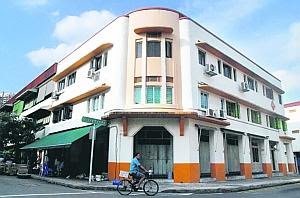

Tiong Bahru estate (top) was designed in the 1930s in Art Deco style.
-- PHOTO: ST FILE


Another front runner mooted by heritage experts is the Botanic Gardens, home to important botanical studies - not least of all, rubber.

Founded in 1859 by the Agri-Horticultural Society on the current site, the Gardens embarked on botanical research after the colonial government took over its administration and launched a scientific journal.

Last year, the Gardens was awarded a Michelin three-star rating, putting it in the ranks of Paris' Eiffel Tower and New York's Empire State Building.

It was also named by Time magazine as Asia's Best Urban Jungle, with a collection of more than 10,000 types of plants, including the region's most significant living collection of documented palms, orchids, cycads and gingers.

Associate Professor Johannes Widodo, a jury member of the Unesco Asia-Pacific Heritage Awards for Culture Heritage Conservation, thinks the Gardens is Singapore's only hope given that most of the country's built heritage has been lost to urbanisation and development.

'World Heritage sites must have a universal value. Buildings such as those in the civic district - Raffles Hotel, City Hall, St Andrew's Cathedral - are probably valuable for Singapore, but not so much meaningful beyond this particular context,' said the lecturer at the National University of Singapore's Department of Architecture.

'Sites like Botanic Gardens have strong connections with the history of the colonial economy in the past, and ecological value in the present - which has become our global concern.'

Since rejoining the United Nations Educational, Scientific and Cultural Organisation in 2007, Singapore has been familiarising itself with the various conventions under the world organisation, according to the secretariat for Singapore's Sub-Commission on Culture and Information for Unesco.

The sub-commission, led by the Ministry of Information, Communications and the Arts, advises the Singapore National Commission on Unesco on issues related to culture and communication.

In a statement to The Sunday Times, it said it is working with relevant government agencies to study the feasibility of nominating 'various cultural landmarks and districts of historical significance for a World Heritage site listing'.
As part of the study, it will look into Unesco's assessment criteria, the benefits and costs of a listing.

A cost benefits analysis that Britain's Department for Culture, Media and Sport commissioned in 2007 showed that a World Heritage site listing has benefited tourism and attracted additional funding, education and civic pride, among other things.

The value of a World Heritage status also means stronger protection of a particular site, since it is subjected to international preservation standards, said Prof Widodo.

dawntan@sph.com.sg

___________________________________________________

Heritage sites in Asia

Cambodia
Angkor (1992)
Temple of Preah Vihear (2008)

Indonesia
Borobudur Temple Compounds (1991)
Komodo National Park (1991)
Prambanan Temple Compounds (1991)
Ujung Kulon National Park (1991)
Sangiran Early Man Site (1996)
Lorentz National Park (1999)
Tropical Rainforest Heritage of Sumatra (2004)

Laos
Town of Luang Prabang (1995)
Vat Phou and Associated Ancient Settlements within the Champasak Cultural Landscape (2001)

Malaysia
Gunung Mulu National Park (2000)
Kinabalu Park (2000)
Malacca and George Town, Historic Cities of the Strait of Malacca (2008)

The Philippines
Baroque Churches of the Philippines (1993)
Tubbataha Reef Marine Park (1993)
Rice Terraces of the Philippine Cordilleras (1995)
Historic Town of Vigan (1999)
Puerto-Princesa Subterranean River National Park (1999)

Sri Lanka
Ancient City of Polonnaruwa (1982)
Ancient City of Sigiriya (1982)
Sacred City of Anuradhapura (1982)
Old Town of Galle and its Fortifications (1988)
Sacred City of Kandy (1988)
Sinharaja Forest Reserve (1988)
Golden Temple of Dambulla (1991)

Thailand
Historic City of Ayutthaya (1991)
Historic Town of Sukhothai and Associated Historic Towns (1991)
Thungyai-Huai Kha Khaeng Wildlife Sanctuaries (1991)
Ban Chiang Archaeological Site (1992)
Dong Phayayen-Khao Yai Forest Complex (2005)

Vietnam
Complex of Hue Monuments (1993)
Ha Long Bay (1994, 2000)
Hoi An Ancient Town (1999)
My Son Sanctuary (1999)
Phong Nha-Ke Bang National Park (2003)

Tuesday, February 10, 2009

the monkey god's birthday procession

I was walking along Guan Chuan St when I saw the procession to commemorate the monkey god's "smaller" birthday.


If you missed the sights and colours today, you can still pop by Eng Hoon Street to catch it tomorrow.

By the way, there is also a Teochew opera in the evening.

Even though I'm a Teochew, I am very sure I won't understand a thing about the wayang to appreciate the script or the plot.

Wonder if they might have those translation headsets for clueless people like me.